Article
Building Your First AI Workflow: Start Small, Scale Smart
Most companies start their AI journey by scoping a moonshot. The teams that win pick something boring instead — a 30-minute task you do three times a week. Here is why low-stakes workflows teach you everything strategic ones cannot.
 FounderAmro MouslyArtificial Intelligence · Technology Strategy · Entrepreneurship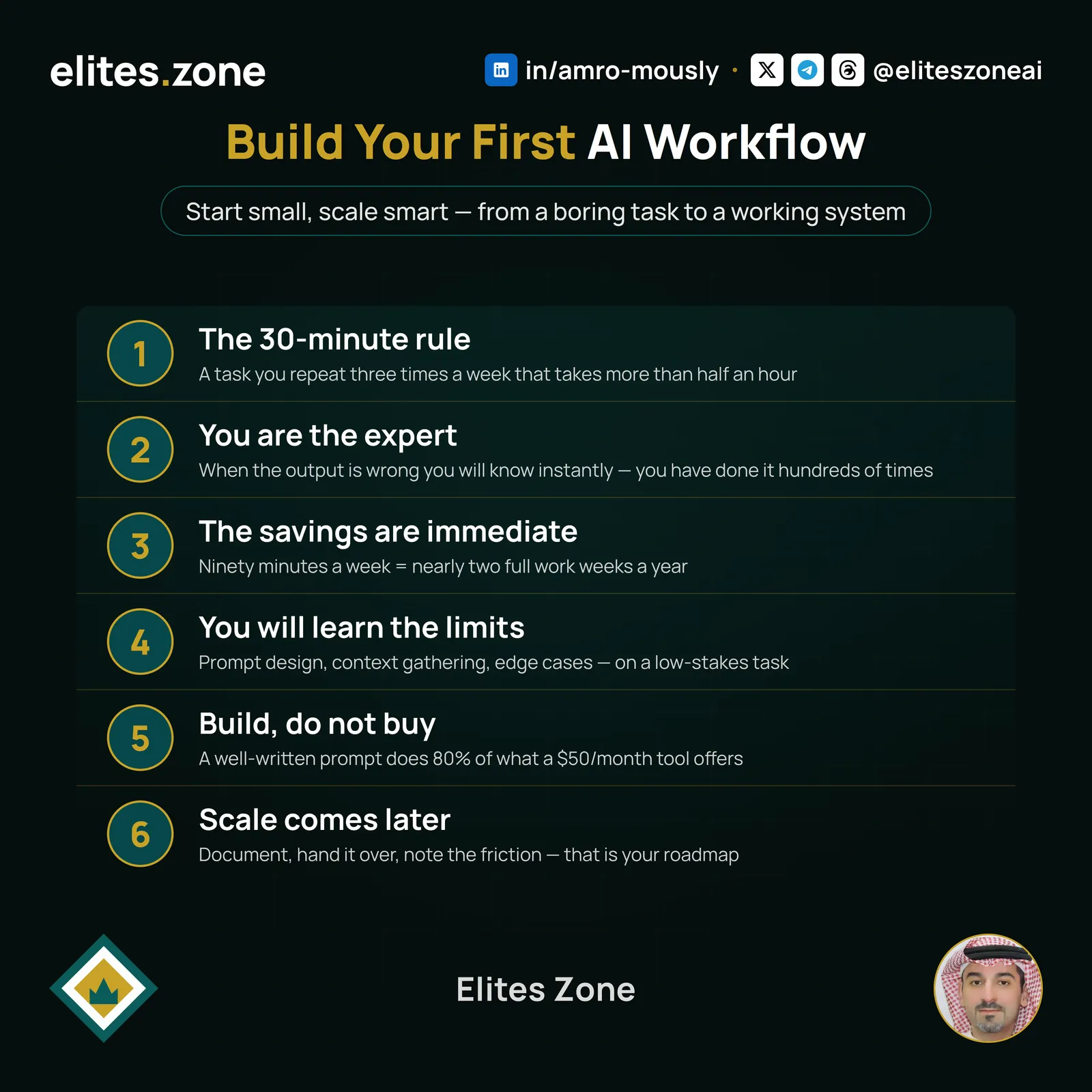
Listen to the lesson
3:11
Most companies start their AI journey wrong. They scope a moonshot, hire a consultant, and burn six months on a system nobody wants.
The teams that succeed do the opposite: they pick something boring.
The 30-minute rule
Before approving any AI initiative, ask one question: "What is a task on my desk right now that I do at least three times a week, takes more than 30 minutes, and follows roughly the same steps every time?"
That is your first AI workflow. Not customer-facing. Not strategic. Just a slow, repetitive task that you understand inside-out.
For most knowledge workers, that is: - Drafting weekly status reports from raw notes - Categorizing inbound emails or support tickets - Pulling specific data points from PDFs or spreadsheets - Writing structured first drafts (proposals, briefs, recaps)
Why "boring" wins
Three reasons:
1. You are the expert. When the output looks wrong, you will know immediately. You will catch hallucinations, tone mismatches, and missing nuance — because you have done this task hundreds of times.
2. The savings are immediate. A workflow that saves you 30 minutes, three times a week, is a 90-minute weekly compounding return. Across a year, that is nearly two full work weeks.
3. You will learn the limits. Every "boring" workflow exposes the real friction in adopting AI: prompt design, context gathering, edge cases, review effort. Better to learn this on a low-stakes task than on a customer-facing one.
Build, do not buy
Resist the urge to buy a polished SaaS tool for your first workflow. Build it yourself with whatever AI you already pay for — ChatGPT Team, Claude, or your existing Microsoft Copilot license. A well-written prompt and a saved template will do 80% of what a $50/month tool offers.
Buy when you have outgrown the manual workflow, not before.
Scale comes later
Once your first workflow runs reliably for two months, do this:
1. Document the prompt and the steps 2. Hand it to a colleague and watch them use it 3. Note every place they get stuck
Those friction points are your roadmap. Now you have a real product to scope, not a fantasy.
The goal of your first AI workflow is not to transform your business. It is to teach you how AI actually behaves when it touches real work. Everything you build after will be better for it.
Insight Score
Rate to unlock