Article
The Map Before the Journey — Where Does ChatGPT Sit Inside AI?
A quick orientation that draws the whole map: from the broad umbrella of AI down to ChatGPT at its centre, and why knowing the layers matters when a vendor tells you they use artificial intelligence.
 FounderAmro MouslyArtificial Intelligence · Technology Strategy · Entrepreneurship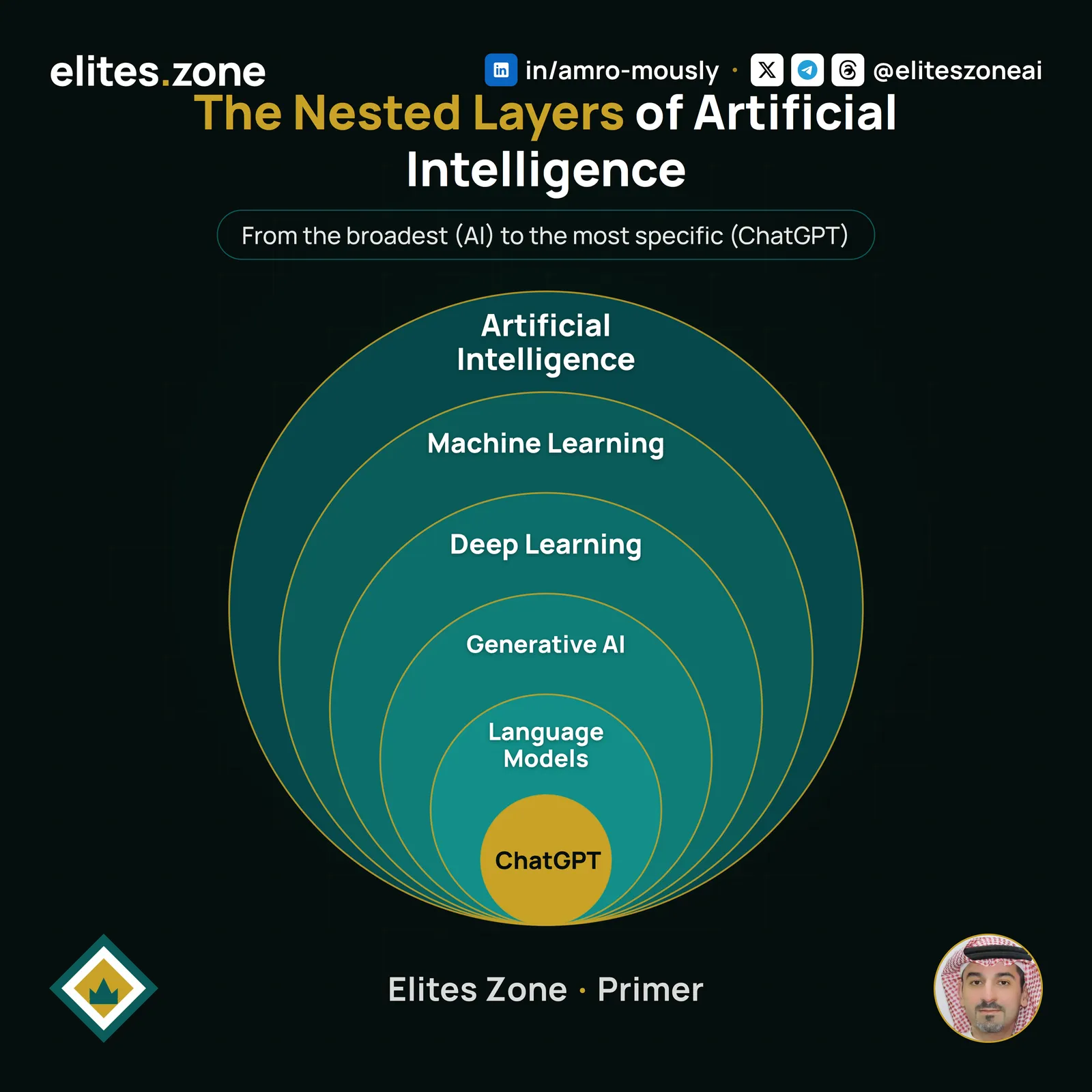
Listen to the lesson
5:55
Before we begin the twenty lessons ahead, let's take a short detour and draw the map. Because before you can understand how AI thinks, you need to know where it sits.
The moment you start following this subject, the vocabulary arrives all at once: artificial intelligence, machine learning, deep learning, generative AI, large language models, and then ChatGPT.
So — are these competing things? Or the same thing under different names?
Neither.
The accurate picture is layers inside layers. Each one sits within a larger one, and the deeper you go, the more specialised it gets.
Picture a city. Artificial intelligence is the whole city; each layer inside it is a smaller, more specialised district, until you reach one particular office called ChatGPT. Drawn out, it looks like circles nested inside circles — each smaller circle more specialised than the one around it.
Let's walk from the largest circle inward.
1. Artificial Intelligence (AI)
The outermost circle. The decades-old ambition: get machines to do work that normally needs human understanding or judgement. Everything below lives under this name.
The analogy: the whole city, with every service and specialisation in it. In practice: a system that helps a radiologist read a scan, routes you around traffic, or flags a suspicious transaction for a bank.
2. Machine Learning
Instead of programming a rule for every case, you let the system learn patterns from examples and data. This is where the real shift began.
The analogy: a specialised district inside the city, where the work is learning from old records and extracting patterns. In practice: predicting which customers are likely to churn based on past behaviour, or forecasting demand for a product in a given season.
3. Deep Learning
A deeper form of machine learning, using neural networks loosely inspired by how brain cells connect. Its strength shows most in images, sound, language and complex patterns.
The analogy: a technical building inside that district, with many teams — each watching one small part, and the decision emerging from the whole picture. In practice: face recognition on your phone, identifying objects in a photo, or understanding speech from audio.
4. Generative AI
Here the machine stops merely classifying or predicting and starts producing something new: text, images, audio, code, ideas.
The analogy: a production department inside that building — not just analysing what exists, but making a new version of it. In practice: a tool that writes an ad, designs an image, summarises a report, or proposes angles for a campaign.
5. Large Language Models (LLMs)
A branch of generative AI specialised in language. Trained on enormous volumes of text so it can read and write in something close to human language.
The analogy: a room dedicated to language and content inside that production department. In practice: a model that answers customer questions, explains an internal policy, turns a long report into decision-ready points, or drafts an email for you.
And at the centre: ChatGPT
ChatGPT is not all of artificial intelligence. It is an application built on a large language model — the point at the centre, not the whole circle.
The analogy: one office inside the language room. Useful and powerful, but not the city. In practice: you write a question or a request, and it returns an explanation, a draft, a plan, a piece of analysis, or an ordered set of ideas.
Why this matters to a decision-maker
Because the moment a vendor tells you "we use AI", the right question becomes: which layer, exactly?
Are we talking about a machine-learning system predicting customer behaviour? A deep model handling images and audio? A generative tool producing content? Or an application built on a language model, like ChatGPT?
The difference between them is large. And once you hold the map, every new tool that appears has a place you can put it — instead of being impressed by the name.
The bottom line
Artificial intelligence is not one layer. It is layers within layers, and ChatGPT sits at the centre: an office inside the language-model room, inside generative AI, inside deep learning, all under the broad umbrella of AI.
Don't mistake the part for the whole.
Learn the map first. Then we can get into how this thing actually thinks — which is the next lesson.
Insight Score
Rate to unlock