Article
How AI Is Changing the Patient Journey in Saudi Government Hospitals
Saudi government hospitals are entering a new phase of digital transformation under Vision 2030. AI is no longer an experiment — it is part of the patient journey, from booking to diagnosis to follow-up.
 FounderAmro MouslyArtificial Intelligence · Technology Strategy · Entrepreneurship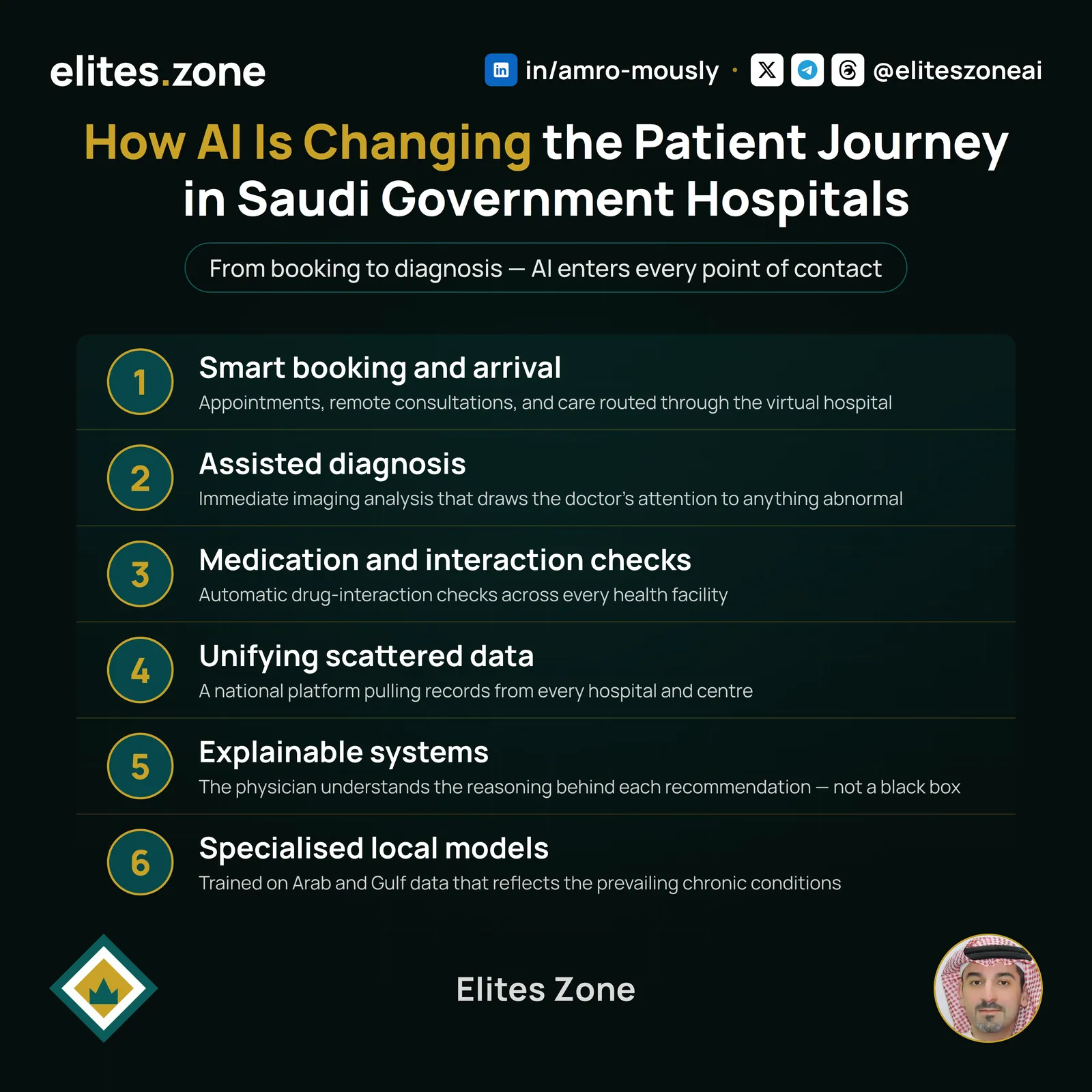
Listen to the lesson
3:15
Picture a patient walking into a government hospital in Riyadh today. They book through the Sehhaty app, and can reach a virtual consultation before leaving home. They arrive at the clinic and the doctor has a fuller record of their history; in some facilities, intelligent systems assist the physician in reading scans or checking medications. This is not a future scenario — parts of it are running today.
Vision 2030 made digital health a priority within the Health Sector Transformation Program, and the Ministry of Health is investing heavily. The Sehhaty app has grown from a booking platform into something broader: appointments, remote consultations, prescriptions and a health record. Triage now runs through the Seha Virtual Hospital — registered with Guinness as the largest virtual hospital in the world — which links dozens of hospitals and delivers specialist expertise to any region without the patient having to travel.
In diagnosis, several major hospitals have activated AI systems that help the physician analyse imaging and flag suspicious areas. The doctor does not read the image alone; they read it alongside an analysis that draws their attention — not a replacement, but a way to reduce the chance of missing a critical detail. And with a unified health record, systems can now check for drug interactions and raise a flag when there is a conflict or an inappropriate dose.
The challenges are not only technical. The biggest problem is fragmented data: a patient visits Jeddah, then Dammam, then Riyadh, and every facility runs a different system — unifying them takes enormous effort. Then there is trust: an experienced physician does not easily accept a machine recommendation, they want to understand its reasoning — so the systems have to be explainable. And there is language: most medical models are trained on Western data that does not reflect Saudi demographics.
Why does this matter to decision-makers? Patients now expect a smooth digital experience like the one they get from financial apps, and medical staff look for advanced environments to work in. Government hospitals have an opportunity to lead regionally — the investment and the vision are there, and what is missing is sustained execution.
Bottom line: the question is not whether AI will enter the patient journey. The question is how to bring it in so that it serves the patient and supports the doctor.
Insight Score
Rate to unlock