Article
Why AI in Arabic Costs 3x More
AI in Arabic costs 3 to 5 times what it costs in English — not because the answer is longer, but because tokenization splits Arabic into more units. If you are building for the Saudi market, budget for token cost from day one and evaluate local Arabic models.
 FounderAmro MouslyArtificial Intelligence · Technology Strategy · Entrepreneurship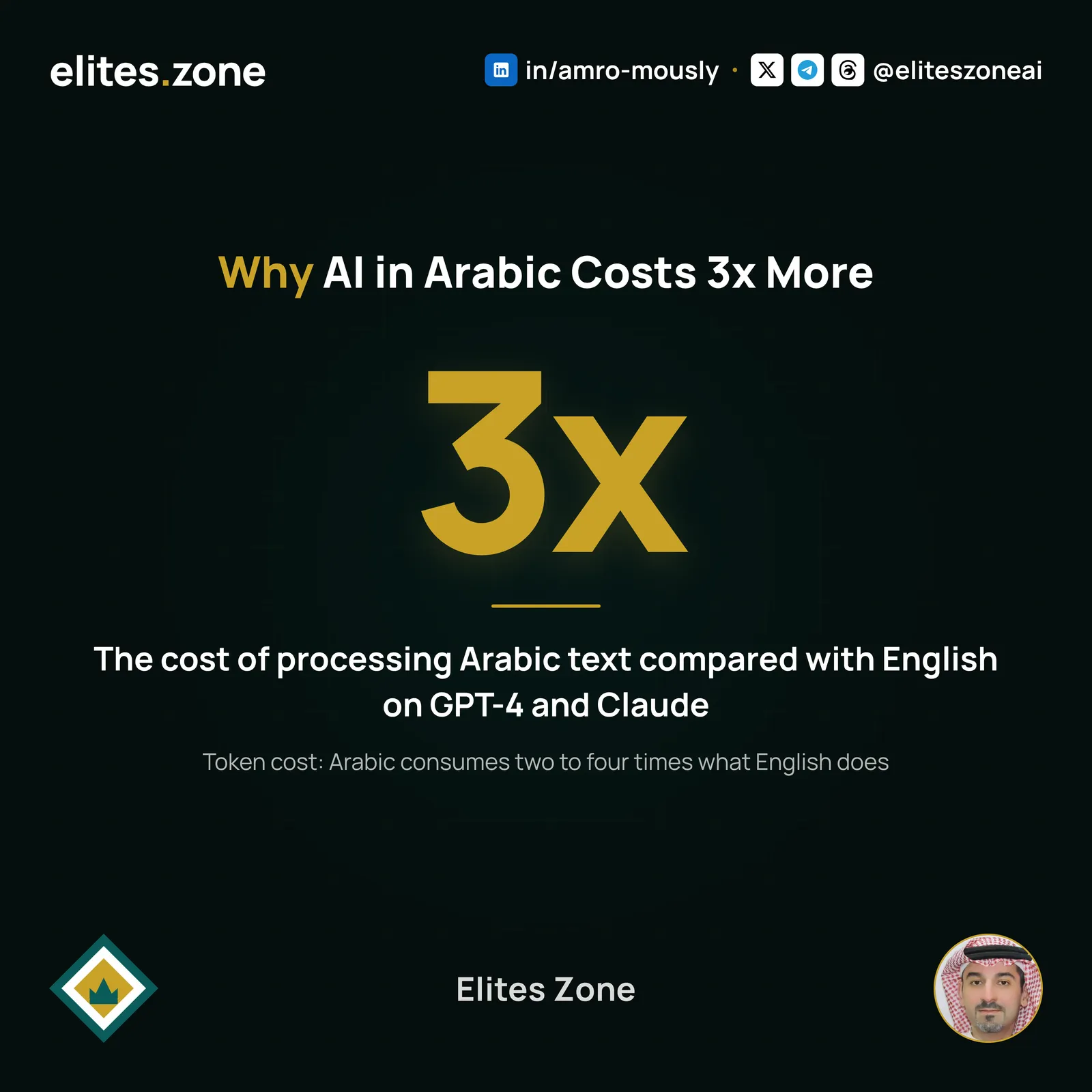
Listen to the lesson
2:53
Ask ChatGPT the same question in Arabic and in English, and you will pay two to four times more for the Arabic version — not because the answer is longer, but because the model reads Arabic in a more expensive way.
The problem starts with tokenization. Models do not read words directly; they split text into small units called tokens. And the dominant method was designed primarily for Latin script: the word "technology" becomes one token or two, but its Arabic equivalent may split into four or five tokens, despite carrying the same meaning.
The reason is that the model learns from data that is mostly English, so Arabic letters — which connect and change shape — are treated as though they were rare, and get broken into smaller pieces. The result is that the same sentence in Arabic takes more room in the model's memory, consumes the context window faster, and costs more on every call.
If you run a product on GPT-4 or Claude and serve Arab customers, this is not a marginal issue — it is a line in your monthly budget. A Saudi company running an Arabic chatbot pays three times what an American company pays for the same service in English. And if you cap conversation length, the Arabic user hits the ceiling quickly while the English user carries on.
The fix exists but has not spread yet. There are tokenizers specialised for Arabic that cut token counts by up to sixty percent. But most large companies did not build their models on them, because the English market is bigger. What is happening now is that local Arabic models — such as ALLaM from SDAIA or Jais from G42 — are trying to close the gap, though they have not yet reached GPT-4's level on complex tasks.
So if you are planning a product for the Saudi market, budget for token cost from day one. It is not enough to take the English price and multiply it by your user count — multiply it by two to four to get close to reality. And consider a local Arabic model for the simpler tasks: it gives you the same result at a quarter of the cost, and keeps your data under local control.
Bottom line: if you are building an AI product in Arabic, budget for token cost from day one — Arabic costs two to four times more.
Insight Score
Rate to unlock