Article
When Do You Need a Private or Local Model?
Not every use of AI needs a private or local model. This lesson separates public, private and local models, and shows how to choose based on data sensitivity, cost and the technical capacity you actually have.
 FounderAmro MouslyArtificial Intelligence · Technology Strategy · Entrepreneurship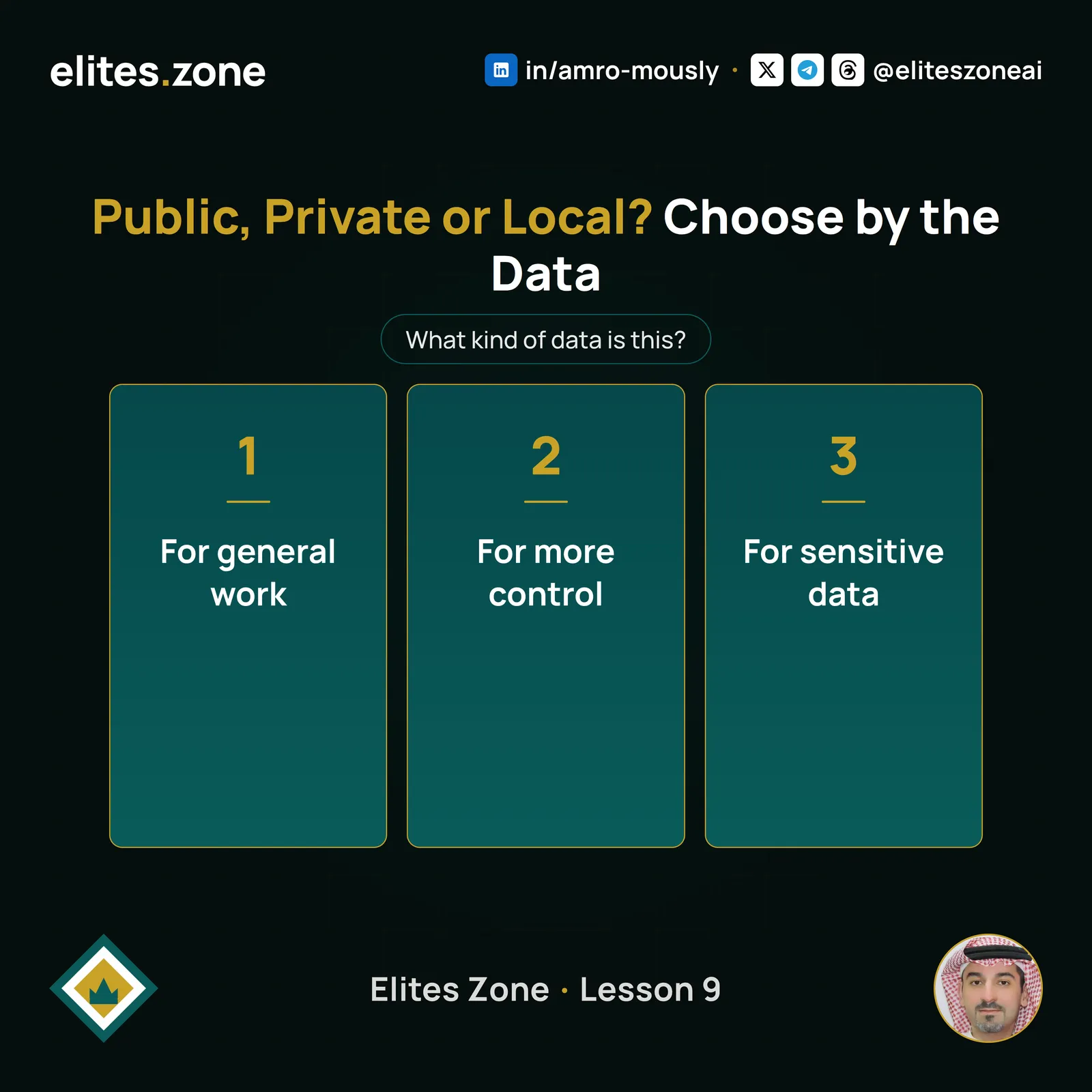
Listen to the lesson
4:03
When people start using AI, one question comes up quickly:
Do I use a public model? Or do I need a private or local one?
It matters, particularly if you hold customer data, internal files, contracts, or anything sensitive.
But the answer is not always "everything must be local." Nor is it "use whatever tool and move on."
It is a matter of degree.
Here is the comparison that makes it concrete.
Sometimes you send a document to a trusted outside firm. Sometimes you need an adviser inside your own company. And sometimes the document is sensitive enough that it must never leave the building.
Models work the same way.
A public model suits general, low-sensitivity work: writing a first draft, summarising non-sensitive text, explaining an idea, proposing headlines, ordering points.
Its advantages are speed and quality, and you build and run nothing yourself. But do not upload trade secrets, customer data, sensitive contracts, or anything you are not authorised to share.
A private model suits situations needing more control: a whole team using the system, permissions, policies, internal data, review.
That might be inside an enterprise environment, or configured so your data is not used for training. It balances quality and protection — and generally needs clearer setup and administration.
A local model is one you run on your own machine or server, with the data staying with you.
Useful when data is highly sensitive, when rules prevent it leaving, when usage is heavy and repeated, or when you need full control of the environment.
But local is not a magic word.
It needs suitable hardware, setup, updates, monitoring and maintenance. And depending on the model and the machine, its quality may sit below the strongest public models.
So don't reach for local simply because it sounds safer.
Start with the right question:
What kind of data is this?
Public? Internal? Confidential? Genuinely sensitive data?
Then ask:
What is the cost of an error or a leak? How often will this run? Do I have the technical capacity to operate and maintain it? Do I need the highest quality, or the highest privacy?
A simple example.
Summarising public articles? A public model is almost certainly fine.
Summarising customer complaints and analysing the causes behind them? More care is warranted, and possibly a private environment.
Medical, legal or financial files, or product secrets? Now a private or local model becomes a reasonable thing to think about.
The bottom line: You do not need a private or local model for everything.
Use a public model for general, low-sensitivity work. Consider a private model when you need control, permissions and stronger protection. Consider a local model when privacy is genuinely high, or you have a clear reason for full control.
Don't choose out of fear alone. Don't choose out of convenience alone.
Choose on the kind of data, the cost of an error, how often it runs, your technical capacity, and the trade-off between quality and privacy.
Quick Check
Before you continue, answer two questions to check the core idea.
- Question 1
When does a local model make sense?
- Question 2
What decides between a public, private or local model?
Insight Score
Rate to unlock