Article
Context Engineering — Getting AI to Understand Your Situation
Context engineering means arranging the task, the background, the examples, the limits and how the result gets judged — so AI understands what you actually want and delivers it consistently.
 FounderAmro MouslyArtificial Intelligence · Technology Strategy · Entrepreneurship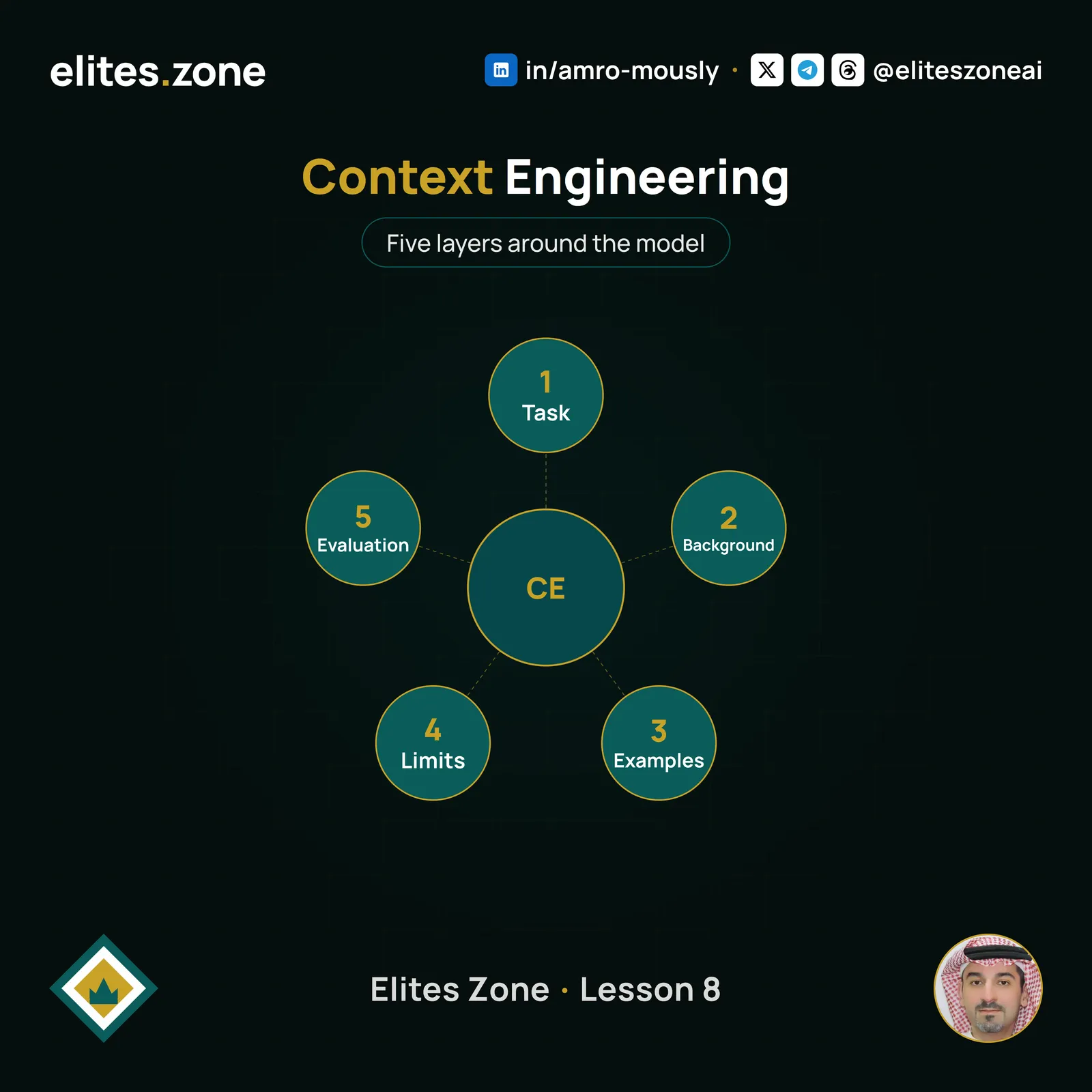
Listen to the lesson
3:35
In the previous lesson we covered how a model may need to consult your own files before answering.
But files alone are not always enough.
You can hand it exactly the right document and still get a generic answer. You can use a powerful model and still find it does not understand your goal, your audience, your style, or your limits.
Which brings us to context engineering.
It means arranging the environment around the model so it understands the task properly.
Not simply a longer question — everything that helps it know what to do, for whom, in what style, and within what boundaries.
Here is the comparison that makes it concrete.
Imagine a capable new employee.
If you say: "Write a proposal for a client."
You will get something generic.
But give them: Who is the client? What is their problem? What is the product? What is the company's style? What is off-limits? What does a good one look like? And when should they check with you before sending?
Now the result is different.
The employee did not suddenly get smarter. The context around them got clearer.
Same with AI.
A good brief matters — context engineering is wider.
The brief is the request you write. Context engineering is the arrangement of everything around it: the instructions, the examples, the files, the memory, the tools, the constraints, and how quality gets judged.
Put simply:
A brief is a good question. Context engineering is a system that makes good questions produce good answers, repeatedly.
Five layers help:
One: the task. What do you want done? Summarise, review, write, compare, extract?
Two: the background. Why are you asking? Who is the audience? Where will the result be used?
Three: the examples. One good example often replaces a long explanation.
Four: the limits. What is allowed and what isn't? May it guess? Must it cite a source? Should it tell you when information is missing?
Five: how it will be judged. How does it know the output is good? Are you after clarity? Brevity? Accuracy? A particular tone?
And this connects back to the previous lesson:
Retrieval gives the model the information. Context engineering gives it how to behave with that information.
You can hand it the right file and still have it used the wrong way, if the goal and the limits were never clear.
The bottom line: A powerful model without clear context will give you an ordinary result.
A mid-tier model with excellent context can give you a genuinely useful one.
Don't pad the request for its own sake. Arrange the context that matters: the task, the background, the examples, the limits, and how it will be judged.
Ask yourself:
Is the problem the model? Or the context I gave it?
Quick Check
Before you continue, answer two questions to check the core idea.
- Question 1
What is context engineering?
- Question 2
What separates a prompt from context engineering?
Insight Score
Rate to unlock