Article
Cybersecurity and Data Protection in the Age of AI
Using AI raises the stakes on data protection. This lesson covers how to think about permissions, data sensitivity, local models, and the security review you need before uploading anything.
 FounderAmro MouslyArtificial Intelligence · Technology Strategy · Entrepreneurship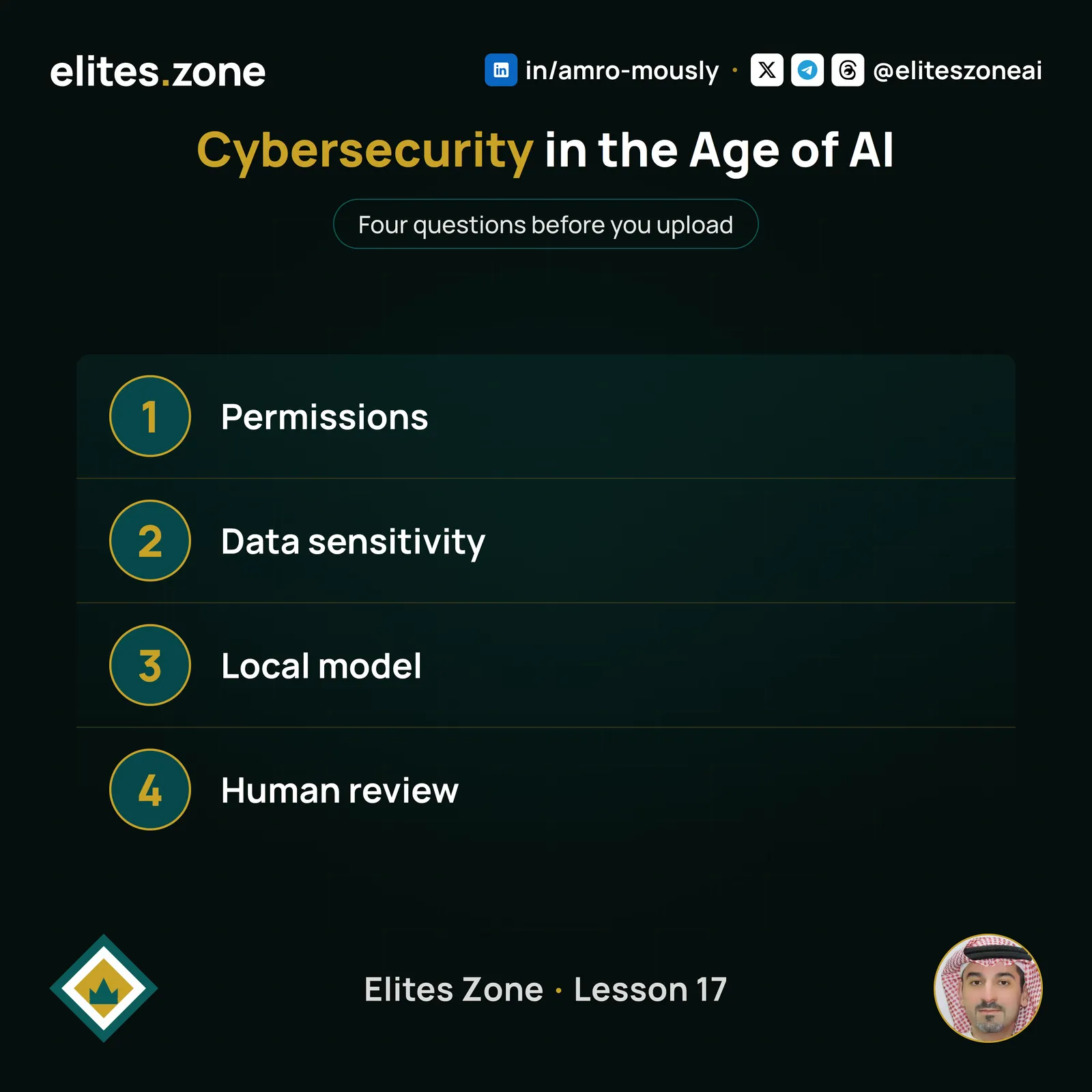
Listen to the lesson
3:09
The more AI gets used, the more data protection matters.
Because AI handles text, files, conversations, images — and sometimes internal or sensitive information.
Which brings in an important idea: cybersecurity.
Cybersecurity means protecting systems and data from unauthorised access, leakage, or misuse.
With AI, the question is not only:
Is the tool useful?
It is also:
What data are we giving it? Where does that data go? Who can see it? And do we even have the right to share it?
Here is a simple example.
If you have a client contract, a payroll file, or an internal report, you should not upload it to any tool without understanding its terms and its privacy policy.
The tool may be excellent. The data is still sensitive.
In some cases a local model is the appropriate choice, to reduce how much data leaves your environment.
Particularly where files are highly sensitive, or rules prevent uploading data to external services.
But a local model is not a magic solution. It reduces some data-sharing risk while needing setup, permissions, updates, and a clear security review of its own.
There is a second point: accounts and permissions.
If the whole team shares one account, or uploads whatever they like without controls, it becomes hard to know who shared what, when, and why.
Better to have clear rules: What may be uploaded? What may not? Who is permitted to use the tool? And how do we review usage?
And a third risk: over-relying on the output.
AI may propose code, a configuration, or a technical step that looks correct but opens a vulnerability or breaches a security policy.
So anything touching accounts, access, passwords, networks, or customer data needs review by a qualified person.
Don't use AI as a final security adviser.
Use it as an assistant: To explain a concept. To summarise a policy. To propose a checklist. To help you understand the risks.
But the security decision and any sensitive implementation need people who specialise in it.
The bottom line: AI does not remove the rules of data protection.
If anything, it makes you need them more.
Before using any tool, ask:
What kind of data is this? Is it sensitive? Am I permitted to share it? Where is it stored? And who is responsible if there is a leak?
Use AI deliberately. Don't let the ease of uploading and copying make you forget the duty to protect.
Quick Check
Before you continue, answer two questions to check the core idea.
- Question 1
What is the first question before uploading a file to an AI tool?
- Question 2
When is a local model the right choice?
Insight Score
Rate to unlock