Article
Ethics and Trust in AI
Trust in AI does not come from how powerful the model is, but from clarity of use, fairness, review, and human responsibility.
 FounderAmro MouslyArtificial Intelligence · Technology Strategy · Entrepreneurship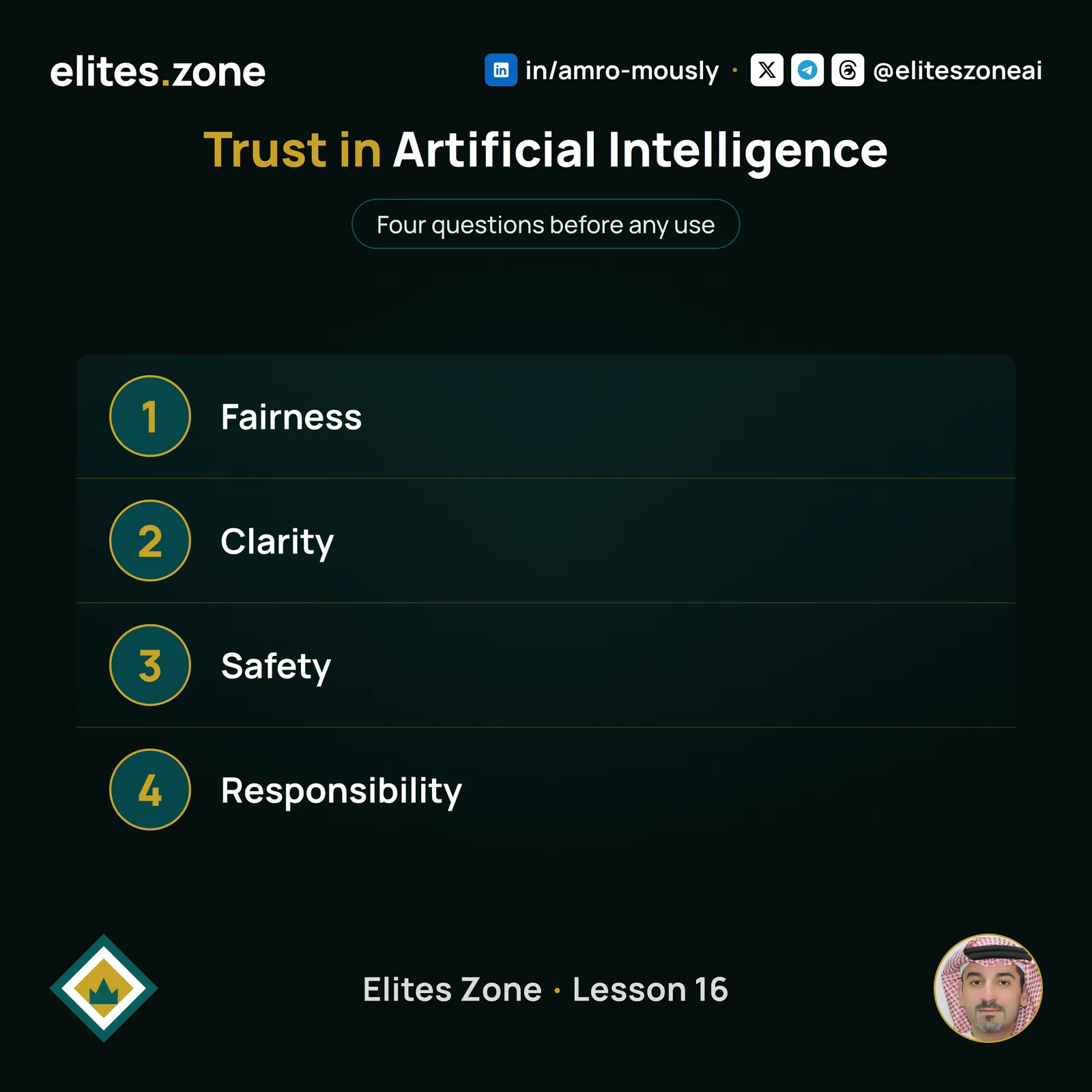
Listen to the lesson
2:41
The more AI gets used, the more the conversation about ethics and trust matters.
Because the question is not only: is the model powerful?
It is also: are we using it in a way that is fair, clear, and responsible?
AI can help you write, summarise, classify, analyse and propose.
It can also get things wrong, carry bias, overstate, or produce a result that reads convincingly and is not fair.
Which brings in an important idea: ethics.
Ethics here means asking, before you use it:
Is this use fair? Does it harm anyone? Does the person know AI was involved? And is there a human responsible for the outcome?
Here is a simple example.
Using AI to order customer messages is an assisting use.
Using it to decide automatically who deserves service, or whose request gets refused, without clear review — that is a sensitive matter.
Because the decision may touch someone's rights, their opportunity, or their reputation.
There is a second dimension: transparency.
You do not have to disclose every technical detail every time. But in consequential cases it should be clear that AI contributed to the outcome — particularly where the decision affects a person.
And a third: bias.
The model learns from large volumes of data and pattern. If the data carries bias, the result can carry it too.
So it is not enough to say: "the system said so."
Ask: Is the outcome fair? Have I reviewed it? Is there a group that could be harmed? Does this decision need a human?
Trust in AI does not come from marketing language.
It comes from clear boundaries: When do we use it? When do we review it? When do we keep it away from the decision? And who carries the responsibility?
The bottom line: Ethics in AI is not a theoretical subject.
It is a daily way of using it.
Use it to help you — but don't let it decide sensitive matters without review.
Trust needs clarity, review, fairness, and human responsibility.
Before any use, ask:
Is this fair? Is this clear? Is this safe? And who is responsible if the outcome is wrong?
Quick Check
Before you continue, answer two questions to check the core idea.
- Question 1
What do ethics mean in the context of using AI?
- Question 2
When does an AI use become ethically sensitive?
Insight Score
Rate to unlock