Article
AI and Jobs — Replacement or Augmentation?
AI does not change whole jobs at once; it starts by changing tasks. This lesson separates replacement from augmentation, and names the skills that grow more valuable.
 FounderAmro MouslyArtificial Intelligence · Technology Strategy · Entrepreneurship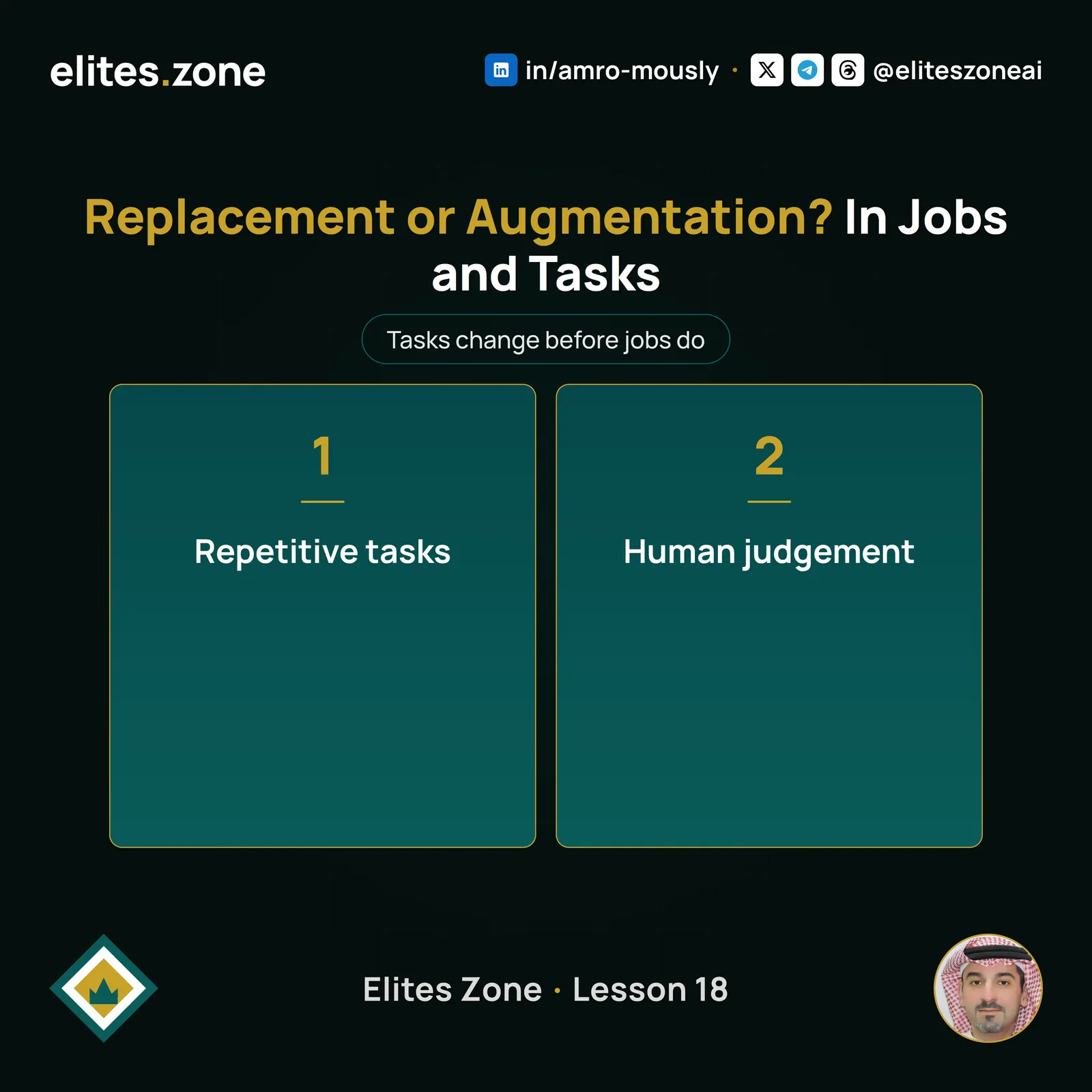
Listen to the lesson
3:21
As AI tools advance, the big question keeps returning:
Does AI replace people? Or help them get better?
The closest answer: both are possible, depending on the kind of work and how it is used.
Some tasks will change. Some tasks will disappear. And some people will become stronger because they know how to use the new tools.
The important distinction is between a job and a task.
A job usually contains many tasks: communication, thinking, coordination, writing, deciding, following up, and human judgement.
A task can be a small, repeated piece: summarising a message, ordering data, writing a first draft, classifying a request.
AI will generally start by changing tasks long before it changes whole jobs.
Which brings in an important idea: augmentation.
Augmentation means the tool does not replace you — it strengthens part of your work.
For instance: An accountant using AI to summarise reports or spot a pattern in expenses. A marketer using it for first drafts and ideas. A teacher using it to simplify an explanation or prepare questions. A customer service agent using it to summarise conversations.
In all of those, the person has not disappeared. The way the work happens has changed.
The real risk to an individual is not that AI exists.
It is carrying on exactly as before while someone else learns to use it.
But that is not a reason for comfort either.
Some jobs and tasks will be strongly affected — particularly repetitive work with little human judgement, and work built on producing text, simple classification, or data entry.
So the practical question is not: Will AI take my job?
The better question: Which part of my work is likely to change? And which skill do I need to develop to stay useful?
The skills that tend to grow more valuable: understanding the problem, asking the right question, reviewing the output, judging quality, working with people, and making a decision you are accountable for.
AI speeds up the work, but does not always know what matters. It produces a first draft, but does not always know what fits the context. It proposes — but it does not carry the consequence of the decision.
The bottom line: Don't treat AI purely as a threat, or as a magic solution.
Learn to use it in your daily tasks. Watch where it genuinely shortens your time. And develop the skills it is least able to substitute for.
The future is probably not human or AI. It is a person who knows how to use AI, alongside a person who doesn't.
Quick Check
Before you continue, answer two questions to check the core idea.
- Question 1
What distinction does the lesson draw between a job and a task?
- Question 2
What does augmentation mean?
Insight Score
Rate to unlock