Article
Automation, Agentic Workflows and AI Agents — The Difference That Matters
Traditional automation, AI-assisted automation, agentic workflows and AI agents are four different things. This lesson separates them, and shows when each is the right level — and when reaching for an agent is overkill.
 FounderAmro MouslyArtificial Intelligence · Technology Strategy · Entrepreneurship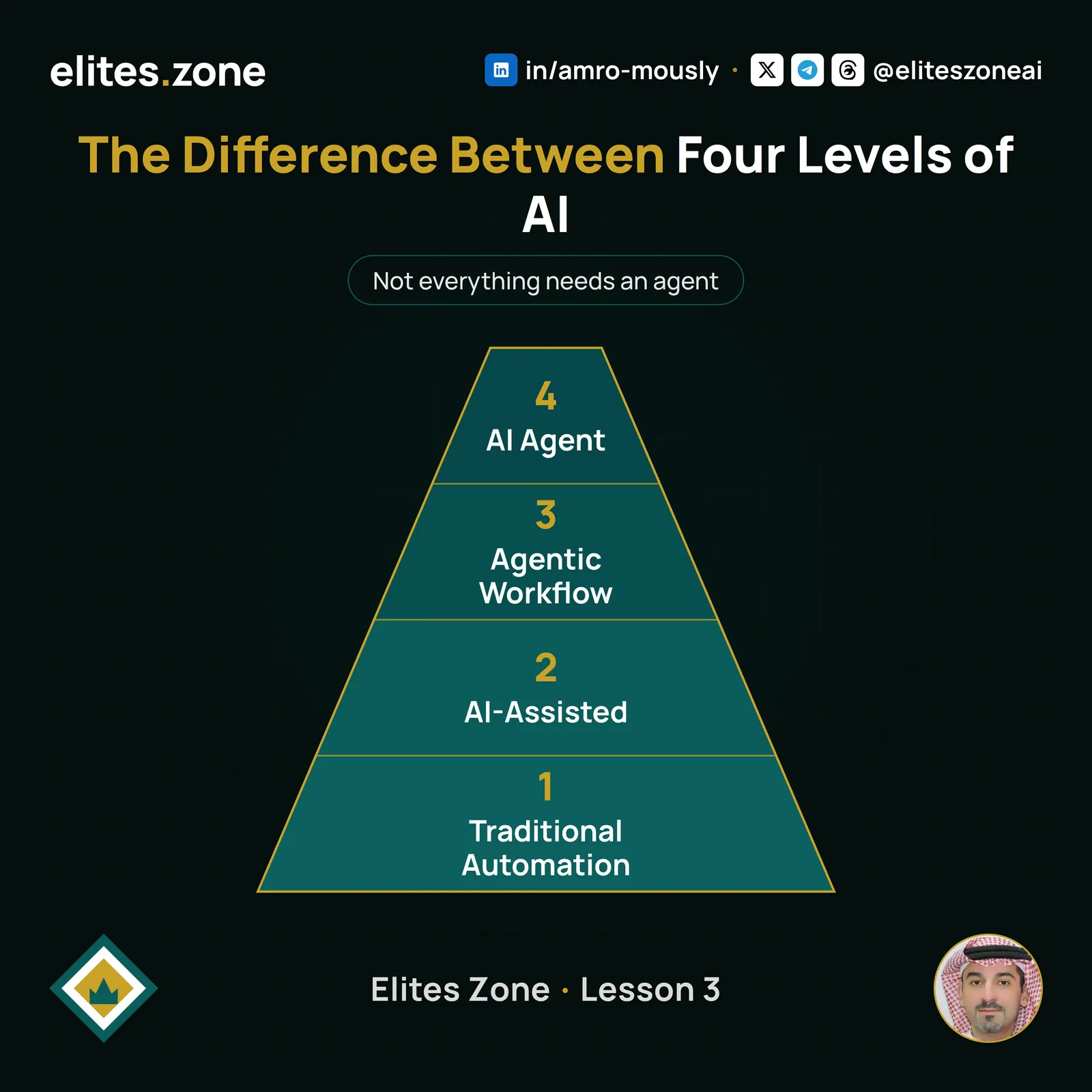
Listen to the lesson
4:13
People hear automation, agentic workflow, AI agent — and assume they all mean roughly the same thing.
The differences matter, because once you can see them you know when a simple tool is enough, when you need a full workflow, and when an AI agent is genuinely appropriate rather than excessive.
Let's start from the ground.
Traditional automation means the system carries out fixed steps instead of a person.
If this happens, do that.
A simple example: A form arrives from Google Forms — send a notification by email and record the details in a spreadsheet.
There is no real understanding here. The steps are explicit and unchanging.
Now, what if we place an AI step inside that path?
That is AI-assisted automation.
For example: A message arrives from a customer; a model reads it and classifies it — complaint, enquiry, or request for a quote — and it is routed to the right team.
The path is still explicit. There is just one intelligent step along the way.
The third level is the agentic workflow.
Here you don't have a single intelligent step. You have a journey with several stops: read, classify, summarise, decide, then act.
But this is the key: the overall path is known from the start.
For example: A workflow receives a customer message, has a model determine the type of request, then picks the next step — route to support, route to sales, or prepare a first draft for a person to review.
Several intelligent steps, all inside a defined route.
An AI agent is a level above that.
An agent does not merely run remembered steps. It works towards a goal.
You give it something like: "Review this problem and propose the best course of action."
It starts reading, uses tools, chooses steps, checks the result, and adjusts its route as it goes — within set boundaries.
A simple example: You ask an agent to look into a struggling marketing campaign. It reads the results, compares channels, proposes a reason for the drop, then asks you before acting.
And here is where care is needed.
An AI agent looks attractive. It is not always the better option.
If the task is fixed and explicit, traditional automation is enough. If it needs light understanding inside a clear path, AI-assisted automation is enough. If the journey has several intelligent steps, an agentic workflow fits. And if the task is an open goal needing tools and changing decisions, that is where an agent starts to make sense.
The problem is that some people start at the agent, purely because the term is new and appealing.
That is a mistake.
The more independent the system, the more it needs boundaries, review, and monitoring.
Not everything needs an agent. Often the simplest solution is the best one.
The bottom line: Don't ask "how do I build an AI agent?"
Ask first:
What kind of task is this? Is it fixed steps? Does it need light understanding? Is it a journey with several stops? Or an open goal requiring changing decisions?
Start with the simplest thing that solves the problem. Then raise the intelligence and the independence only when you actually need to.
Quick Check
Before you continue, answer two questions to check the core idea.
- Question 1
Which example is closest to traditional automation?
- Question 2
What is the core difference between an agentic workflow and an AI agent?
Insight Score
Rate to unlock