Article
How Does AI Think? And Why the Way You Ask Changes the Answer
How you ask an AI changes what you get back. This lesson explains what a prompt really is, and why being clear about the task, the audience, the format and the limits produces a materially better answer.
 FounderAmro MouslyArtificial Intelligence · Technology Strategy · Entrepreneurship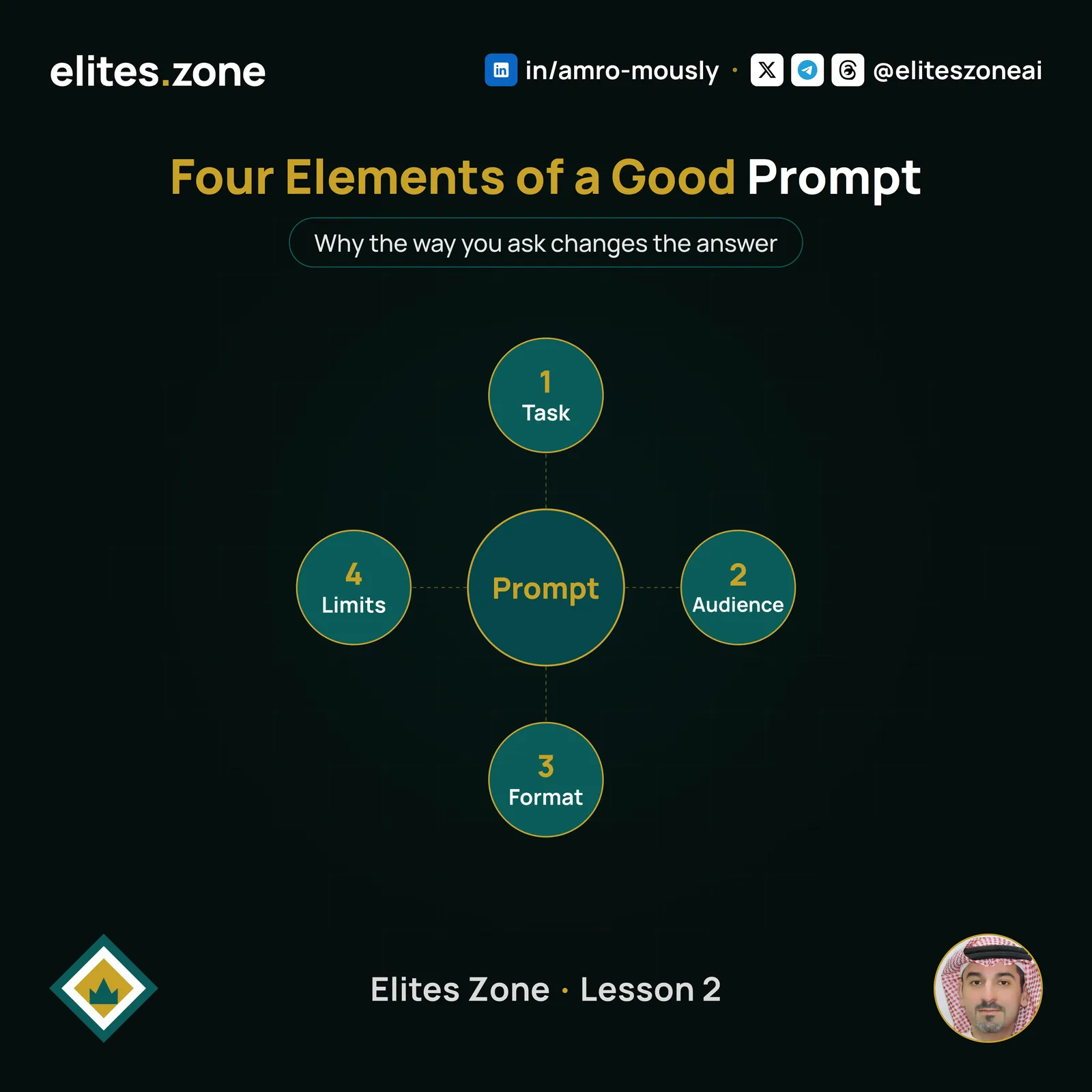
Listen to the lesson
4:24
Most people treat AI like a more advanced search engine.
They type a quick question and wait for a precise, finished answer.
But language models do not work the way search does. They are not "opening the internet" and returning a ready-made result. They are predicting the best response they can, based on your question, your instructions, and the patterns they learned from.
Which brings us to the idea of the prompt: the way you write your request to the model.
That is why how you ask matters.
Ask something general and you will usually get something general. Ask something incomplete and the model will fill the gaps itself. Ask something clear and specific and your odds of a useful result go up sharply.
Here is the comparison that makes it concrete:
AI is like a capable employee who is new to your business.
If you say:
Write me a post.
They will be thinking: about what? For whom? In what tone? Long or short? Is the goal awareness or sales? Are there examples? Anything they should avoid saying?
Without those details, they will guess.
Sometimes the guess lands. But in real work, you don't want to depend on luck.
Better to say:
Write a short LinkedIn post for business owners explaining the difference between automation and AI, in a plain, practical tone, with an example from customer service, and no marketing hype.
You haven't just written a longer question. You have given a clearer brief.
And a clear brief needs enough context: the task, the audience, the format, and the limits.
Four things make your asking better:
One: the task. Say exactly what you want: summarise, compare, review, write, extract, or propose.
Two: the audience. Text for a business owner is not the same as text for a student, a developer, or an executive.
Three: the format. Do you want a table? Bullets? A short paragraph? An email? A post? A list of decisions?
Four: the limits. What is off the table? Should it avoid overstatement? Cite sources? Say "I don't know" when the information isn't there? Surface its assumptions?
The clearer those are, the less guessing you leave behind.
And one point worth being precise about: a good brief does not mean writing a lot of words for their own sake.
Two clear lines often beat a page of contradictory detail.
Length is not what you're after. Clarity is.
Instead of:
Analyse this text.
Say:
Pull the three main problems out of this text, and for each one give a likely cause and a short, practical fix.
And instead of:
Write me content about AI.
Say:
Write a plain introduction for a non-technical reader explaining why AI helps organise work but does not replace human judgement.
Now the model knows the task, the audience, and the angle.
One more thing to watch: AI can hand you a confident answer even when it has misread the question. So ask it, sometimes:
What assumptions did you build this answer on? Where might you be wrong? What here would need checking?
Those questions expose the edges of the answer.
The bottom line: AI gives you a better result when you give it a clearer brief and enough context.
Don't treat it as though it reads your mind. Treat it as a capable assistant who needs a clear assignment.
Before you ask, ask yourself:
What is the task? Who is the output for? In what shape? What are the limits?
The clearer the brief, the closer the answer lands to what you actually needed.
Quick Check
Before you continue, answer two questions to check the core idea.
- Question 1
What does the lesson mean by a prompt?
- Question 2
Which request gives the model the best chance of a useful answer?
Insight Score
Rate to unlock