Article
Why Does AI Get Things Wrong? And When Should You Trust It?
AI can hand you a confident answer that simply isn't right. This lesson explains hallucination, how to grade your trust by risk, and where human review stops being optional.
 FounderAmro MouslyArtificial Intelligence · Technology Strategy · Entrepreneurship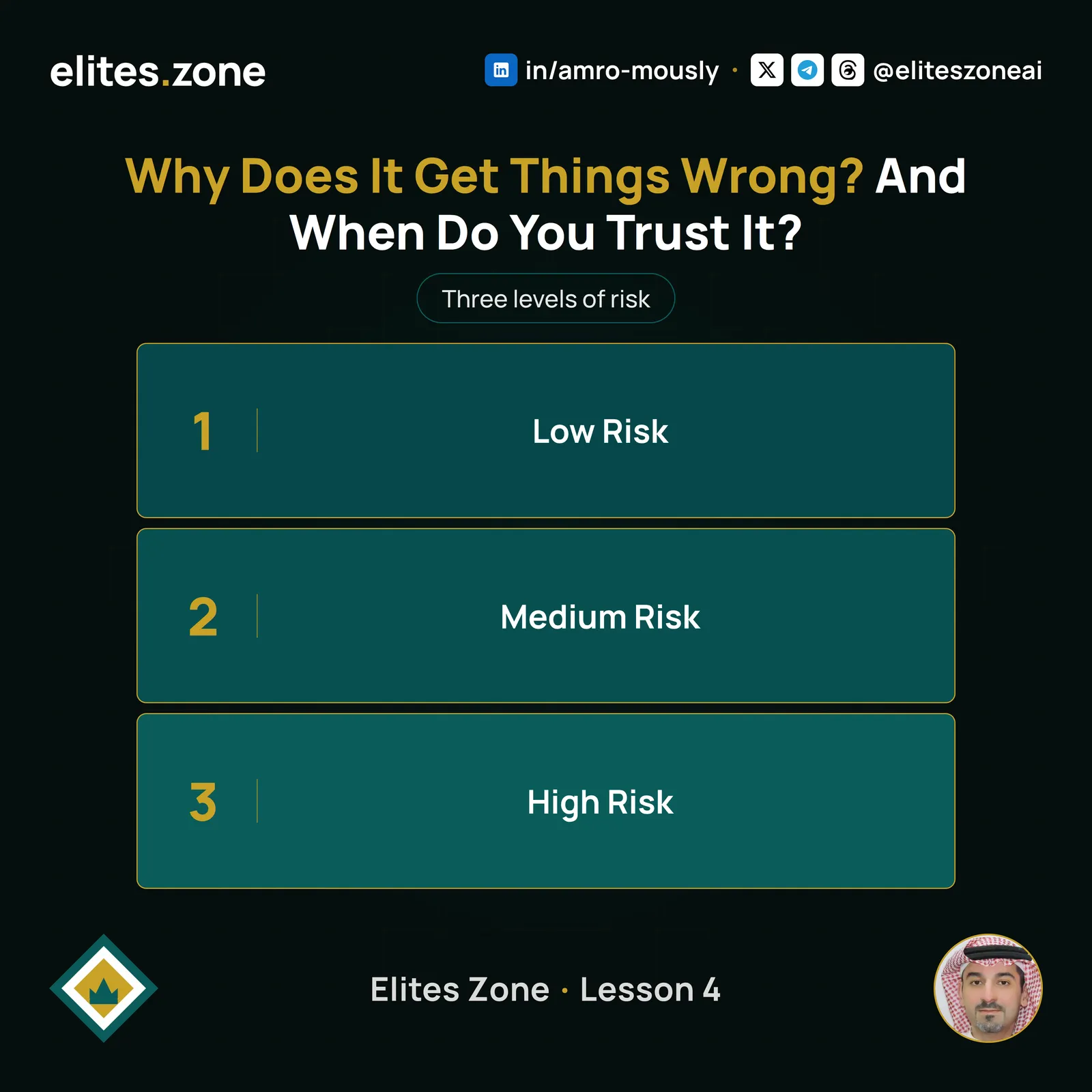
Listen to the lesson
3:50
People are often impressed by AI's answers.
The response is well organised. The language is strong. The explanation sounds confident.
And that is exactly the problem:
A confident answer is not the same as a correct one.
AI can be wrong. It can hand you an inaccurate fact. It can give you something that reads as perfectly logical and is not true.
Which brings us to a term worth knowing: hallucination.
A hallucination is an answer that sounds convincing but isn't grounded in accurate information or a real source.
Here is the comparison that makes it concrete.
Picture someone very bright and very fluent — who almost never says "I don't know."
Ask them about something they only half know, and they will complete the picture. If they lack the information, they may guess. And if your question itself was unclear, they may build on a wrong assumption.
That is close to what happens with AI.
It is trying to give you the best possible answer — but "best phrased" is not the same as "most accurate."
So trust has to be graded.
There are low-risk uses: summarising an idea, proposing a headline, ordering points, writing a first draft.
Here a mistake is usually easy to spot and fix.
There are medium-risk uses: analysing a report, reviewing a proposal, summarising an important meeting.
Here you check the numbers, the names, and the decisions.
And there are high-risk uses: medical, legal or financial decisions, or anything touching people's rights.
Here AI cannot be the one deciding. It can help you understand the situation or order the questions, but the decision needs a qualified person and explicit human review.
So how do you work with it safely?
First: don't accept an answer because it is confidently written. Confidence of style is not evidence of accuracy.
Second: ask for its sources, or ask it to flag where verification is needed. Especially where there are numbers, names, dates, or sensitive instructions.
Third: use it for the first draft, not the final judgement. Let it help you start; you review.
Fourth: on work that matters, give it a clear source. A file, a policy, a text, specific data. Don't leave it relying on general memory alone.
Fifth: ask it review questions: Where might you be wrong? What assumptions did you build this on? What here needs checking?
These won't eliminate error, but they take the air out of unfounded confidence.
The bottom line: AI is a powerful tool and it is not infallible.
Don't reject it outright because it makes mistakes. Don't trust it outright because it writes with confidence.
Use it well: for understanding, summarising, organising, and first drafts.
But on sensitive decisions, keep it an assistant — not the one deciding.
Always ask yourself:
Is this a low-risk use? Do I need to verify against a source? And if this is wrong, is the cost trivial — or is it harm?
Quick Check
Before you continue, answer two questions to check the core idea.
- Question 1
What is a hallucination?
- Question 2
When does human review matter most?
Insight Score
Rate to unlock