Article
AI in the Small and Family Business
Small and family businesses do not need a large AI project to begin. This lesson covers starting from one repeated, low-risk task that saves your team real time.
 FounderAmro MouslyArtificial Intelligence · Technology Strategy · Entrepreneurship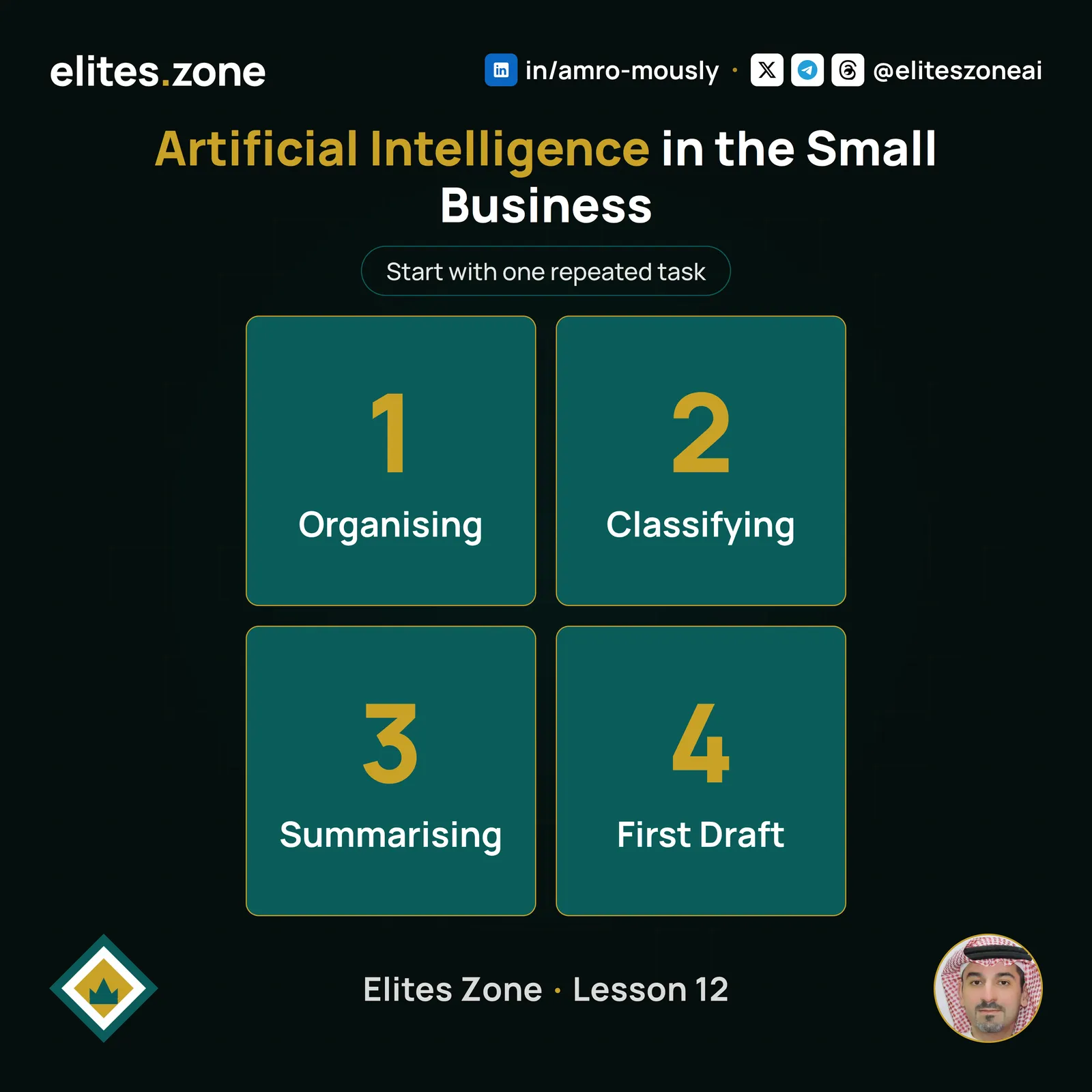
Listen to the lesson
2:53
Small and family businesses have a genuine opportunity with AI.
But the opportunity is not in buying lots of tools. It is in improving the everyday things that repeat and consume your team's time.
In a small business every hour carries weight. Every small error takes something from the owner or the staff.
Which is why the smart place to start is the repeated tasks.
For instance: Customer messages. Invoices. Follow-ups. Repeated replies. Meeting summaries. Ordering requests. Preparing first drafts of proposals.
None of that needs a large project on day one.
It needs you to ask:
Where does our time go each week? What do we repeat most often? Which task, if it improved, would take pressure off the team?
Here is a simple example.
If you run a shop or a services office and receive many customer messages, you can use AI to help classify them: enquiry, complaint, request for a quote, or follow-up.
It does not have to reply instead of your employee. It is enough that it orders the messages and prepares a first draft of the reply.
You have not replaced a person. You have taken the chaos off them.
Another example.
If you produce similar quotes repeatedly, AI can help prepare the first version from the customer's details, and your employee reviews it before it goes out.
The important idea: Don't start with the riskiest task.
Not a large financial decision, not a sensitive reply, not something that touches customer trust directly.
Start with a task that is clear, repeated, and low-risk.
In a small business, AI succeeds on simplicity.
If the solution needs long training, heavy maintenance and daily supervision, it is usually wrong for a start.
A good solution is one the team describes as:
"That genuinely saved us time."
Not the one that looked impressive in a demo and added a new burden.
The bottom line: A small business does not need to begin with a large AI project.
Start with one repeated task. Let AI help with ordering, classifying, summarising, or the first draft. Keep a person reviewing anything sensitive.
Ask yourself:
What repeats most here? Can we improve it without much risk? And does the solution save real time — or add new complexity?
Quick Check
Before you continue, answer two questions to check the core idea.
- Question 1
Where should a small business start with AI?
- Question 2
Which example fits a practical start in a small business?
Insight Score
Rate to unlock