Article
AI in Customer Service
AI in customer service is strong at classifying, summarising and drafting replies — but it must not make promises or decide sensitive cases without human review.
 FounderAmro MouslyArtificial Intelligence · Technology Strategy · Entrepreneurship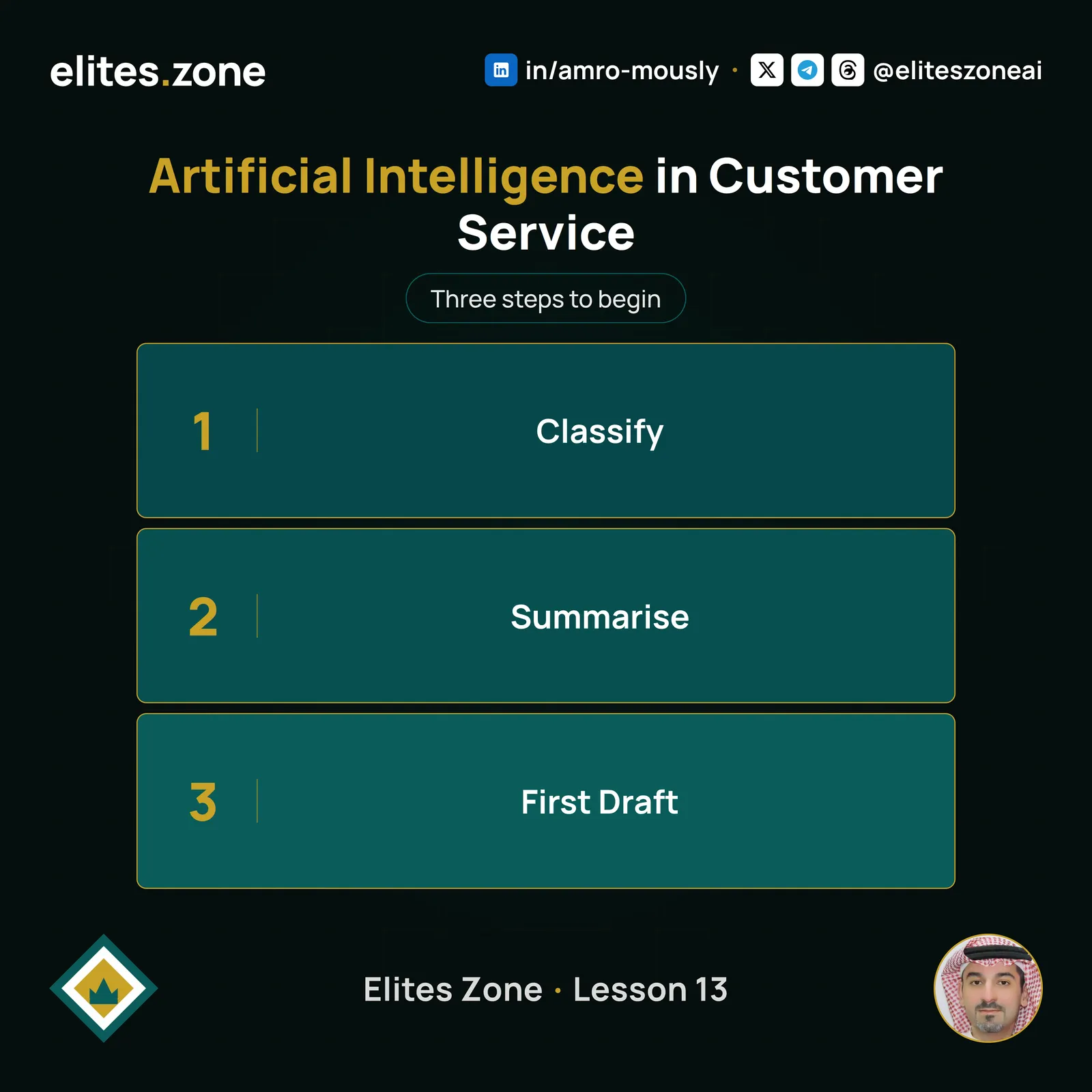
Listen to the lesson
3:03
Customer service is one of the clearest places to benefit from AI.
It has repeated questions, high message volume, time pressure, and a need for replies that are clear and courteous.
But using AI here needs care.
Because a customer is not interacting with a "technical experience". They are dealing with trust, and a problem they want solved.
The simplest use of AI in customer service is ordering.
For instance: reading the messages, classifying them, and determining whether each is a complaint, an enquiry, a support request, or a sales lead.
That helps the team know where to start.
A second use is summarising.
On a long conversation with a customer, AI can summarise the problem, note what has already happened, and propose the next step.
Instead of reading twenty messages from the beginning, your employee starts from a clear summary.
A third use is the first draft of a reply.
AI writes a courteous initial response, and the employee reviews it before it is sent.
And here the distinction matters.
In customer service, do not let AI make promises of its own.
It must not say: "You will be compensated." Or: "The problem has been resolved." Or: "We guarantee this."
Unless that sits in a clear, approved policy.
The simple rule:
Let it help with understanding and wording. Keep a person responsible for the decision and the promise.
If you have a knowledge base or a set of common questions, you can connect it so replies stay close to your actual policies.
But even then, review.
Because an outdated file, an incomplete policy, or an unclear question can produce a wrong reply.
The best start is three steps:
One: classification. Order messages by type and priority.
Two: summarisation. Condense long conversations for your team.
Three: the first draft. Write an initial reply, then have a person review it.
Don't start with fully automated replies on day one.
Especially on complaints, returns, compensation, or anything sensitive.
The bottom line: AI is excellent in customer service when you use it as an assistant to the team.
It orders, summarises, and prepares a first draft.
But don't let it make promises, decide, or handle sensitive cases without review.
Start behind the scenes. Improve the team's speed and their grasp of the situation. Then expand carefully.
Quick Check
Before you continue, answer two questions to check the core idea.
- Question 1
What is the best first use of AI in customer service?
- Question 2
Why be careful with fully automatic replies in support?
Insight Score
Rate to unlock