Article
AI in Management and Strategic Decisions
AI helps leadership summarise information, compare options and surface risks — but it does not replace human judgement on decisions that matter.
 FounderAmro MouslyArtificial Intelligence · Technology Strategy · Entrepreneurship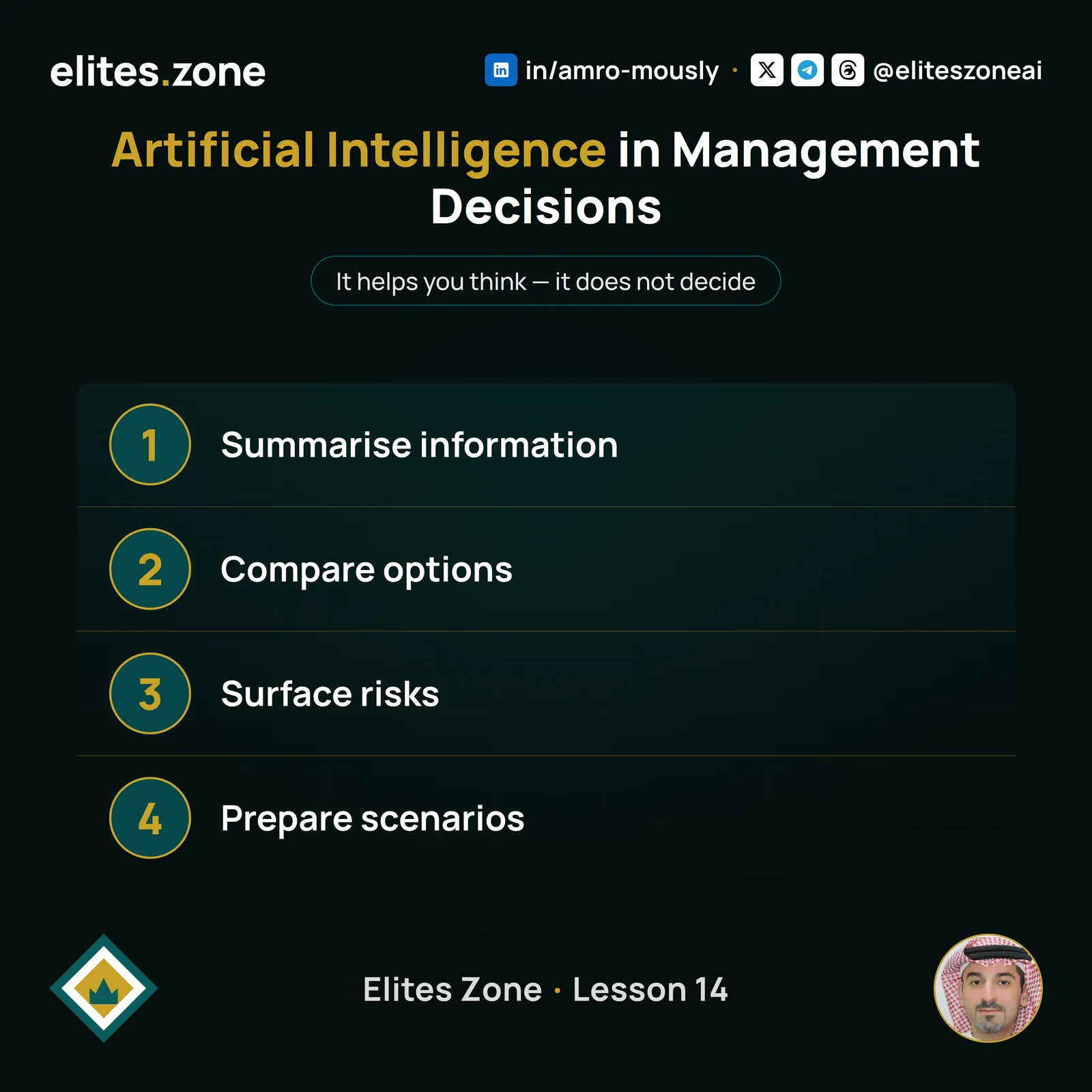
Listen to the lesson
3:07
A management decision rarely rests on a single piece of information.
Usually you have numbers, reports, opinions from the team, time pressure, and risks that have to be weighed.
AI can help here — with one important condition:
It helps you think. It does not decide for you.
In management, the useful application of AI is in arranging the picture.
For instance: Summarising a long report. Comparing options. Surfacing risks. Preparing questions for a meeting. Turning a long discussion into clear decision points.
That is genuinely valuable, because some decisions are delayed not because the team lacks knowledge, but because the information is scattered.
Here is a simple example.
Say the decision is: do we open a new branch, or focus on improving the existing one?
You can give AI a sales summary, customer feedback, operating costs and the team's views, and ask:
What are the options? What are the risks? What are the assumptions? What questions need answering before we decide?
AI is not giving you the final decision. It is helping you see the decision clearly.
On strategic decisions this matters more, because a mistake can cost time, money and reputation.
So don't use it as the decision-maker.
Use it in roles like: - first-pass analyst - organiser of ideas - surfacer of assumptions - help in preparing scenarios
And always ask it:
What assumptions did you build this on? Where might you be wrong? What information is missing? What is the worst outcome if we take this path?
Those questions stop you being impressed by an answer that is well organised and incomplete.
There is an important rule in management:
AI is strong at arranging information and weak when the source is partial or biased.
Give it incomplete data and you get incomplete analysis. Give it one side's opinion and it may build on that as though it were the full picture.
Which is why a management decision needs good data, clear context, and human review.
The bottom line: Use AI in management to organise the thinking, not to replace the judgement.
Let it summarise, compare, surface risks, and prepare the questions.
The final decision belongs to the person accountable for it.
Ask yourself before any decision:
Did I give it the full picture? Have I checked the assumptions? And does this decision need human expertise or explicit sign-off?
Quick Check
Before you continue, answer two questions to check the core idea.
- Question 1
What is AI's proper role in a management decision?
- Question 2
Which question best exposes a weak AI analysis?
Insight Score
Rate to unlock