Article
AI in Your Personal Day
The best place to start with AI may be your own day. This lesson covers using it for organising, learning, writing and everyday decisions — without letting it decide for you.
 FounderAmro MouslyArtificial Intelligence · Technology Strategy · Entrepreneurship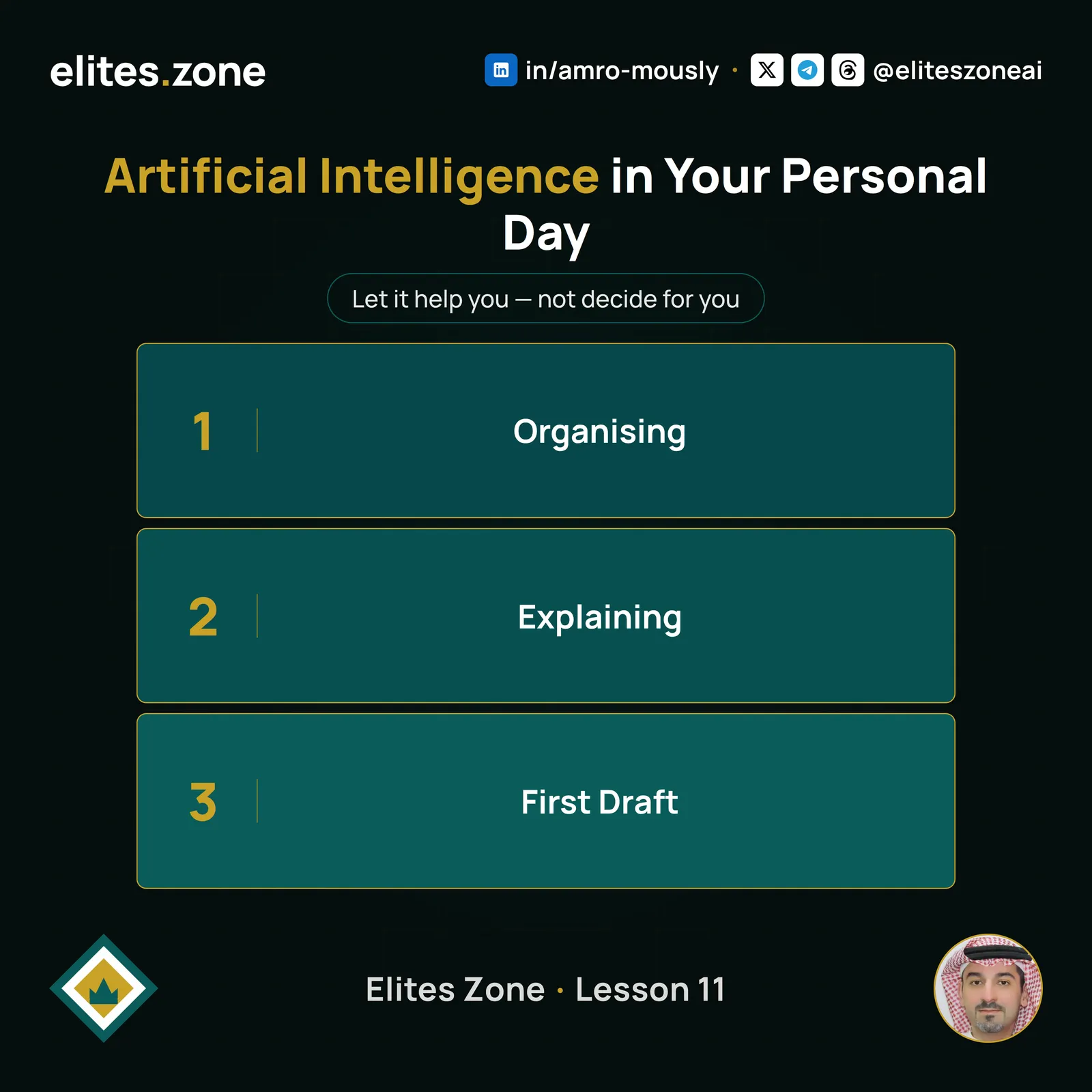
Listen to the lesson
2:56
Using AI does not have to start with companies and large projects.
Often the best place to begin is your own day.
Because you learn without much pressure. You experiment without much risk. And you understand how the model thinks before you try it on work that matters.
But the important part: don't use it as a substitute for your own mind.
Use it as an assistant that organises, explains, proposes, and shortens.
You can use it to plan your day, for instance.
Give it your task list and ask it to help you order them by priority, energy and time.
Not because it knows your life better than you do, but because it helps you see the picture from a clearer angle.
You can use it to learn.
If a subject is difficult, ask it to explain simply, then give you an example, then ask you two questions to check the idea landed.
Here AI becomes something like a teaching assistant — though you still review and verify, particularly on anything sensitive.
You can use it to write.
An email, a polite reply, a summary of an idea, notes ordered before a meeting.
Instead of starting from a blank page, it starts the first version and you rewrite it in your own voice.
And you can use it on small everyday decisions.
Comparing two options. Laying out the pros and cons. Working out the questions you should ask before deciding.
But be careful here.
AI helps you think. It does not live your life for you.
It does not know all your values. It does not know your full circumstances. And it does not carry the consequences of your decision.
So let it help you get clear — not decide on your behalf.
Three uses make an excellent starting point:
One: organising. Order your tasks, your ideas, or your notes.
Two: explaining. Ask for a concept simplified, an example, or a learning plan.
Three: the first draft. Use it to start a message, a plan, or a piece of text — then edit it yourself.
And stay away from using it on sensitive decisions without review.
Health, money, relationships and rights are not settled by a quick answer from a model.
The bottom line: Start with AI in your own day — deliberately.
Let it organise, explain and propose. Don't let it decide for you.
The more you learn to use it on small things, the more clearly and calmly you will use it later at work.
Quick Check
Before you continue, answer two questions to check the core idea.
- Question 1
What is the best personal use of AI?
- Question 2
Why does the lesson suggest starting with personal use?
Insight Score
Rate to unlock