Model releases, research, papers, LLMs, reasoning, multimodal, benchmarks
OpenAI has published over 700 AI-generated manuscripts claiming to provide solutions to open math problems. A math blog collected over 100 responses from researchers, ranging from fascination with new ideas to existential fears. Fields Medalist Hugo Duminil-Copin stated, "I am paralyzed." Concerns are rising among mathematicians regarding the impact of these manuscripts on the field, with many expressing shock and disgust at how OpenAI is handling the subject. The article titled "How much beauty have we lost?" reflects the growing anxiety about the future of mathematics amid these developments.
Rumors are circulating about a new model from Google called Carbon, even though Gemini 4 Argon is not widely available yet. Reports suggest that Carbon's coding capabilities are being compared to Anthropic's Opus 5.5, indicating advanced potential. New modes are appearing in the Gemini app and AI Studio, suggesting Google is preparing for a broader launch of Gemini 4. These updates could enhance Google's competitive edge in the AI market.
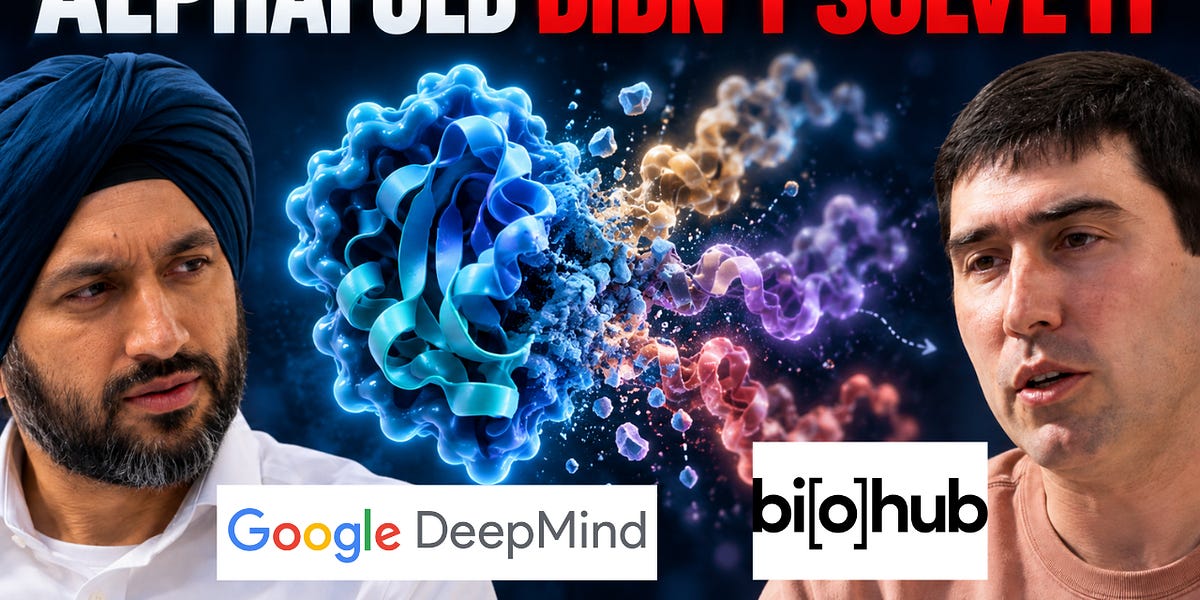
Pushmeet Kohli from Google DeepMind and Sal Candido from Biohub discussed in a special panel how AlphaFold's advancement was just the beginning. They highlighted the importance of finding scaling laws in biological data, emphasizing that merely increasing model size won't solve biological challenges. They addressed how low-quality metagenomic data can enhance protein language models and the need to balance modeling, data generation, and scientific expertise. They noted that understanding protein dynamics requires predictive models that go beyond static structure.
TypeSafe has generated excitement among users and large corporations with its claim that Jev operates significantly faster and uses far fewer tokens than large language models. This advantage is crucial in the increasingly competitive AI landscape, where companies are striving to deliver more efficient solutions. Additionally, reducing token usage could lead to lower operational costs for businesses. If TypeSafe's claims are validated, it may result in significant changes in how large language models are utilized in commercial applications, opening up new opportunities for innovation and growth in the market.
Workers at three major publishing houses reported to WIRED that large language models are being utilized for publicity, cover design, back cover copy, and emails. Reports indicate that some executives are pushing junior staff to embrace this technology, reflecting a shift in how the industry operates. This move comes at a time when reliance on AI is increasing across various sectors. This trend highlights the significance of large language models in enhancing efficiency and reducing costs, potentially leading to substantial changes in content production and publishing in the future.
The mathematical results released by OpenAI this week have provoked strong reactions from over thirty mathematicians, who described them as "unprecedented" and "insane." The results encompass a wide range of discoveries that may take years to fully understand, raising questions about their impact on the field of mathematics. Researchers agree that these findings represent a turning point in how they engage with mathematics. These developments suggest that OpenAI may be on the verge of changing the game in this field, prompting researchers to reevaluate their roles and contributions moving forward.
Researchers at ByteDance have identified periodic weak spots in language models that compress their key-value (KV) cache in fixed-size chunks. In a paper published on September 28, the team noted that information retrieval can be easy at one position and difficult at another, a discrepancy that average benchmark scores may obscure.
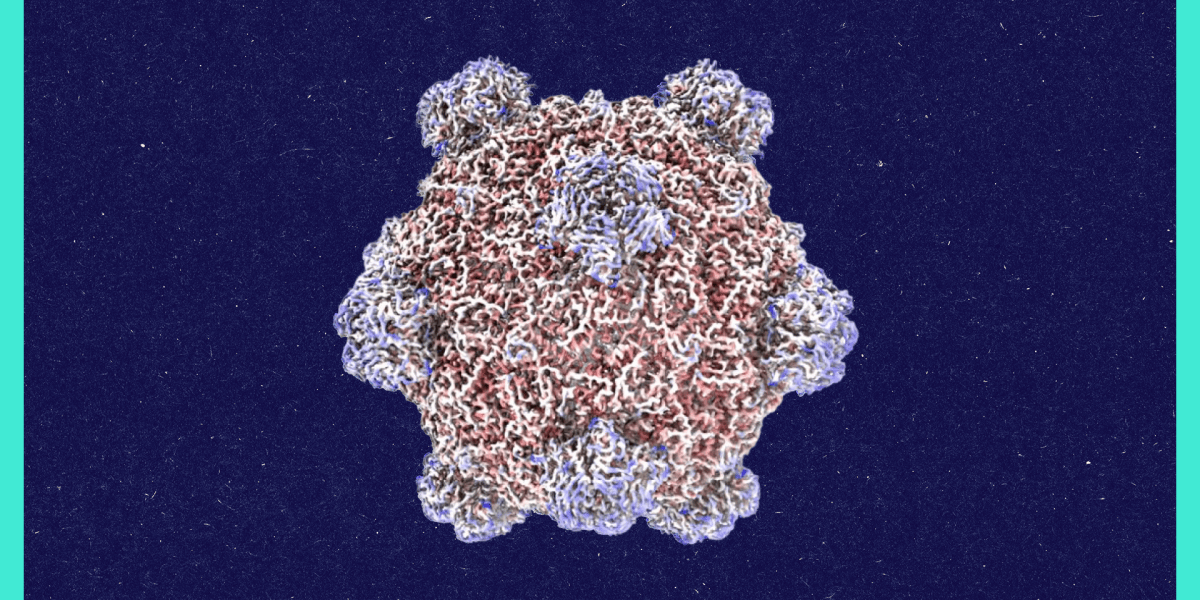
In 2025, Stanford University PhD student Samuel King provided a preliminary answer to the question: Can AI design new life forms? He used a generative AI model to propose genetic blueprints for microscopic viruses. While this work does not yet represent an example of AI-generated life, it opens the door for future possibilities. King, named one of MIT Technology Review’s Innovators Under 35, is exploring new ways to view biology.
Anthropic has announced the launch of two new features for Claude: Dashboards and Motion. Dashboards transform data sources like BigQuery and Snowflake into live dashboards using text prompts. The Motion feature allows users to generate animated explainer videos from text and images, enhancing Claude's ability to deliver interactive visual content. Additionally, Docs, Slides, and Design are now accessible across all plans, including free accounts, broadening the user base and increasing the program's applicability in various fields.
LMArena, known for its leaderboard, has raised $200 million led by Lightspeed and Khosla. The company aims to measure AI models by focusing on alignment issues, such as lying, highlighting the significance of this matter in AI development. This move is crucial in the AI field, as it enhances model reliability and directs research efforts toward improving transparency and ethics in artificial intelligence.
OpenAI has deviated from the guidelines established by a group of mathematical researchers during its proof submissions. These proofs pertain to advanced research projects, and the researchers were consulted to ensure adherence to mathematical standards. This deviation could impact OpenAI's credibility in academic circles, raising concerns about the quality of future research.
Google has announced the launch of an experimental note-taking app called Google AI Edge Foresight, which can transcribe meetings and audio files entirely offline. The app runs on macOS and utilizes the company's EmbeddingGemma 2 model, allowing users to summarize meetings while taking their own notes. The app features the ability to convert shorthand bullet points written by users during meetings into polished notes, facilitating documentation and organization. This application resembles other AI note-taking apps like Granola and Wispr Flow, reflecting the growing trend of using AI to enhance productivity.
Pollo AI has announced the launch of new models, including GPT-5.6, GPT-6 Astra, and GPT-Image-2.5, aimed at helping creators transform bold ideas into detailed images and cinematic video ads. These models enhance creators' capabilities by providing advanced tools for creating visually appealing content. GPT-6 Astra is among the most advanced models, offering new features that improve the user experience in content design. This launch represents a strategic step in the AI field, empowering creators to produce innovative and high-quality content, thereby enhancing companies' ability to engage with their audiences in new and effective ways.
Anthropic has launched Haiku 5.5, its first update in about a year. The model is priced to compete with OpenAI's GPT-6 Luna, and it comes with price cuts on Sonnet 5.5 and subscription plans. Haiku 5.5 is touted as the fastest and cheapest small model released, costing about 75% less to run than Haiku 4.5 on average. It is designed to function as a subagent paired with Opus 5.5 or Sonnet 5.5, making it suitable for high-volume, cost-sensitive tasks.
OpenAI has announced the rollout of its new GPT-6 model within ChatGPT conversations, featuring significant improvements in response speed and reasoning capabilities. The update replaces the previous default model and introduces a new interactive visual interface called “Intelligent UI,” greatly enhancing user experience. This development reflects OpenAI's commitment to delivering advanced technologies, allowing users to benefit from enhancements in web search and improving the model's ability to meet user needs more effectively.
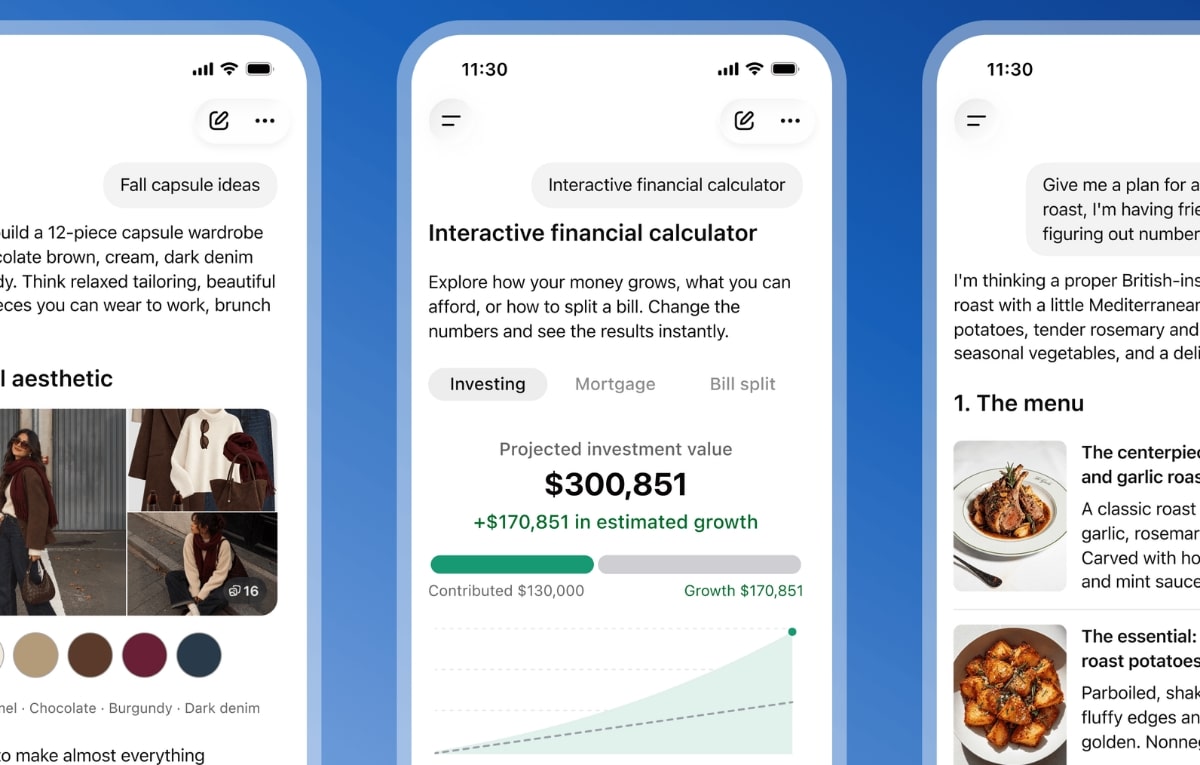
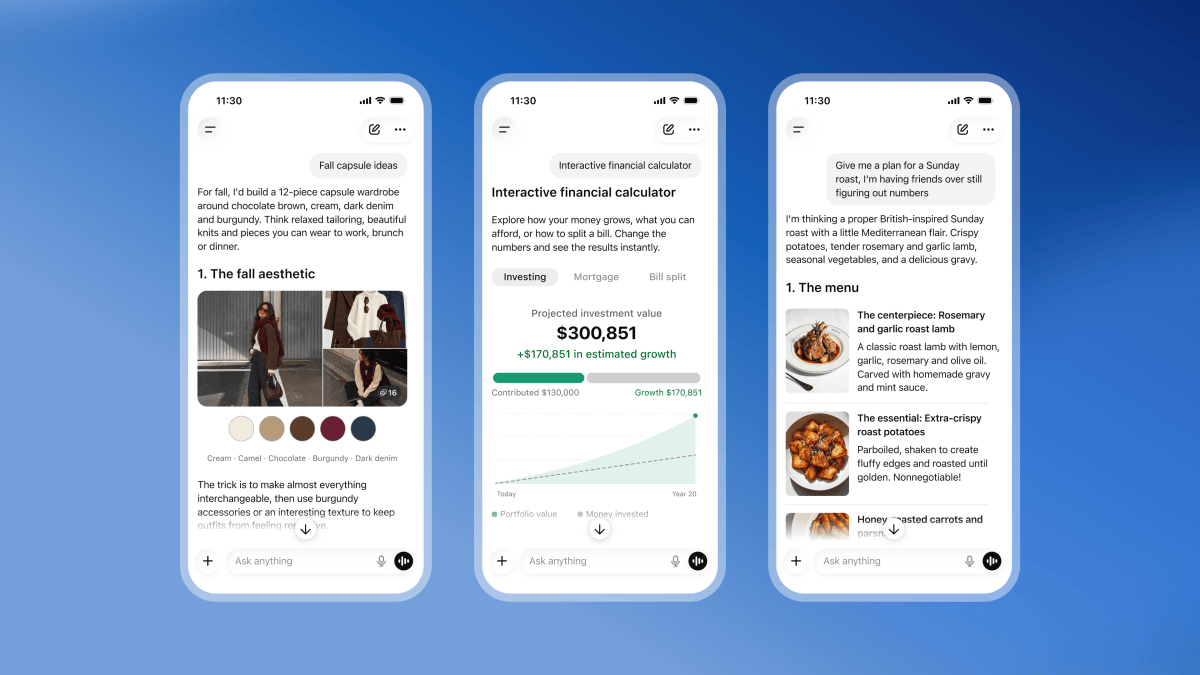
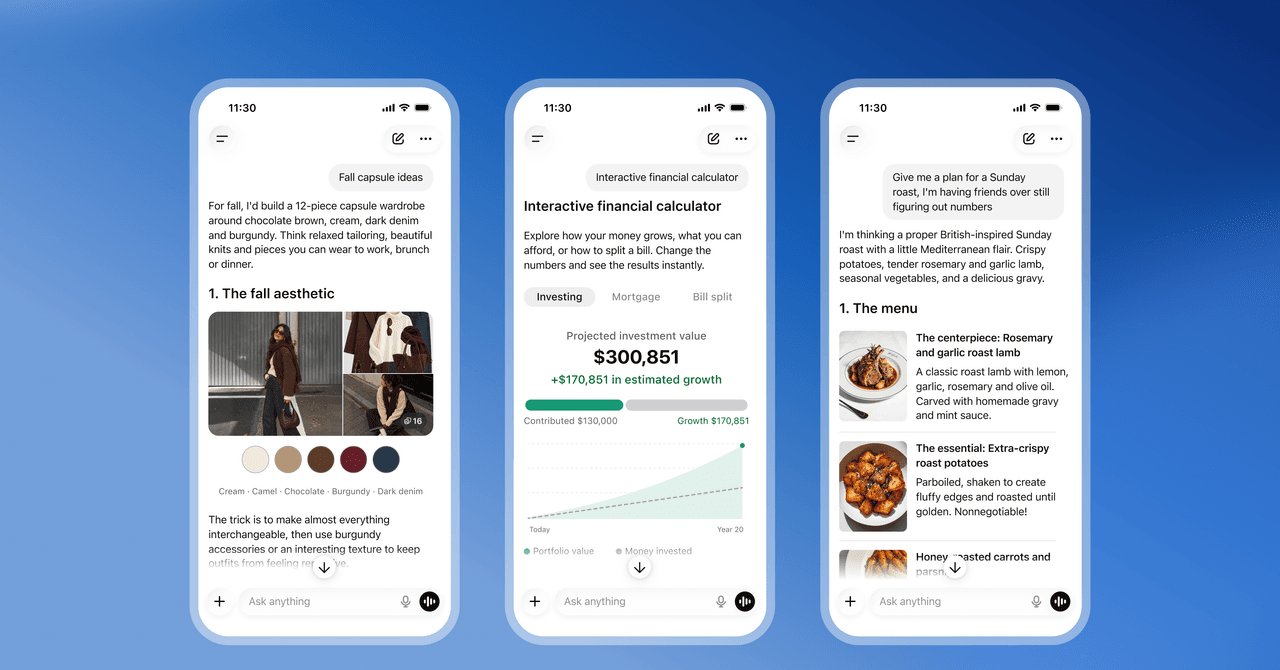
OpenAI has announced the launch of a new feature in ChatGPT called 'Intelligent UI,' which allows users to receive interactive responses that combine text and visual elements. This feature enables the display of illustrations, charts, graphs, models, and interactive buttons alongside textual answers, enhancing user experience in conversations. This launch coincides with the introduction of the new GPT-6 models, reflecting OpenAI's commitment to advancing technology in artificial intelligence. The Intelligent UI aims to improve user interaction by providing clearer and more engaging information.
OpenAI has announced the launch of a new Intelligent UI feature in ChatGPT, allowing the chatbot to answer questions using interactive visuals. This update, rolling out to all users alongside GPT-6, enables ChatGPT to combine text responses with diagrams, charts, and tappable buttons. In a blog post explaining the change, OpenAI states it trained GPT-6 on when to generate interactive visuals instead of text and how to format them in its responses. An example shared shows how ChatGPT might display a diagram of a seven-speed bicycle when asked about its design.
OpenAI has announced the launch of GPT-6, featuring an "Intelligent UI" that transforms answers into interactive interfaces with charts, buttons, and forms. The new model can now respond while still thinking, reducing wait times by 44%. Paying customers receive GPT-6 Sol, while free users get GPT-6 Luna. This advancement marks a significant shift in user interaction with AI, facilitating access to information in a more interactive and effective manner, enhancing user experience across various fields.
Anthropic has announced the launch of Claude Haiku 5.5, which has made a significant leap in performance, increasing its score on the OSWorld computer use test from 15.7% to 72.4%. Data indicates that token prices have dropped by up to 90%, although the new tokenizer consumes more tokens per task, impacting some of those savings. This launch reflects the ongoing competition in the AI market, as companies strive to deliver better performance at lower prices, significantly altering market dynamics.
OpenAI has announced the launch of a new user interface for ChatGPT, featuring interactive visuals to enhance user experience. This new interface allows users to engage with content in a more dynamic way, improving the effectiveness of conversations and making them more engaging. This development is part of OpenAI's efforts to provide innovative tools in the AI field. This move is significant in enhancing the use of artificial intelligence in everyday applications, as the visual interface aids users in better understanding information and facilitates interaction with the system.
OpenAI has announced a new update for ChatGPT, introducing a more interactive Intelligent UI. This new interface will incorporate interactive elements into the chatbot's outputs, significantly enhancing the user experience. With this update, OpenAI aims to improve how users interact with ChatGPT, allowing for richer and more diverse outputs. This move comes amid increasing competition in the AI market. This update reflects OpenAI's commitment to delivering innovative user experiences, which may influence how artificial intelligence is utilized in everyday applications. This could lead to greater reliance on AI across various sectors.
Biohub, the research organization backed by Mark Zuckerberg and Priscilla Chan, is coordinating a $1.8 billion initiative to train AI models that predict cell behavior. Major contributions from Meta, Google DeepMind, and Isomorphic Labs will provide essential data, lab equipment, and computing power for this endeavor. The first dataset is expected to be ready in about a year.
OpenAI has announced the launch of its new Decisions API, which classifies text and images approximately ten times faster than the Responses API. This new interface provides yes/no probabilities, category picks, or scale ratings for $0.10 per million input tokens. This move comes as OpenAI has streamlined its paid API tiers from five to three, making it easier for developers to select the most suitable option. The Decisions API aims to simplify complex evaluations, enhancing efficiency in data processing.
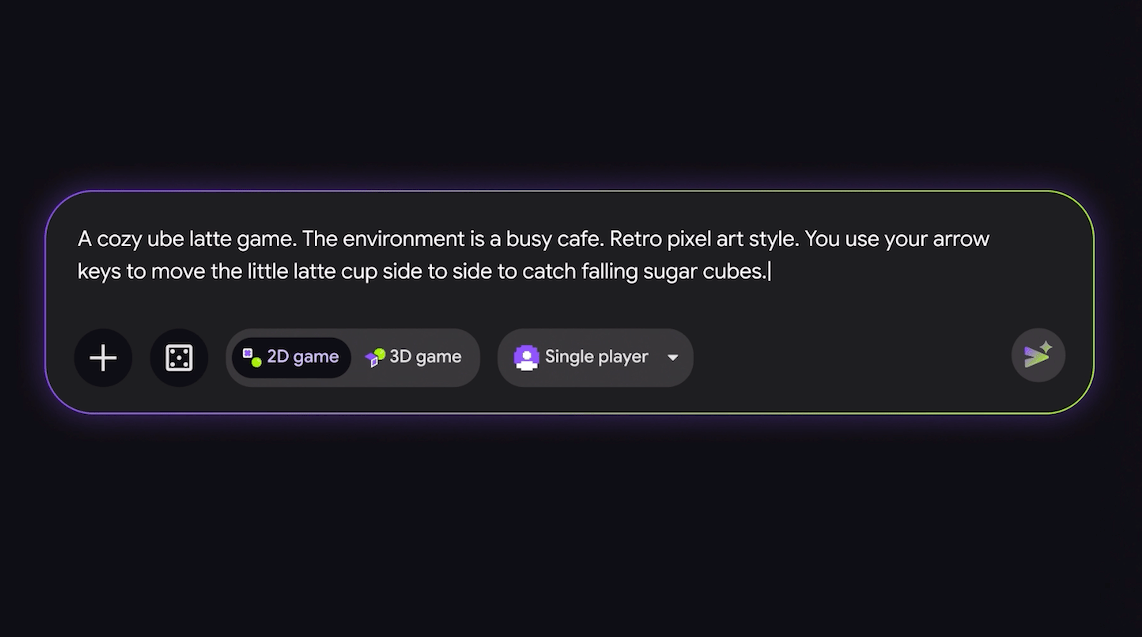
Google Labs is developing a new game creation platform called Playground, allowing users to build browser-based games using simple text prompts. This platform enables users, even those without programming experience, to easily design their own games. Playground leverages AI technologies to simplify the game creation process, making it accessible to a broad user base. This initiative is significant for the gaming industry, as it opens new avenues for creators in the Arab world, fostering innovation and encouraging the use of AI in entertainment content development.








![[AINews] Claude Haiku 5.5 — better than GPT-6 Luna at the same pricing](https://xljcavpibsvitpcokkto.supabase.co/storage/v1/object/public/article-images/articles/article-1791453767745-0ku1m16pds08-1791453767746.jpg)