Article
Why Relying on One AI Model Is Risky for Your Business
Cost and speed are the real challenge in AI applications — modern orchestration platforms save up to 60% of the bill and protect you from outages.
 FounderAmro MouslyArtificial Intelligence · Technology Strategy · Entrepreneurship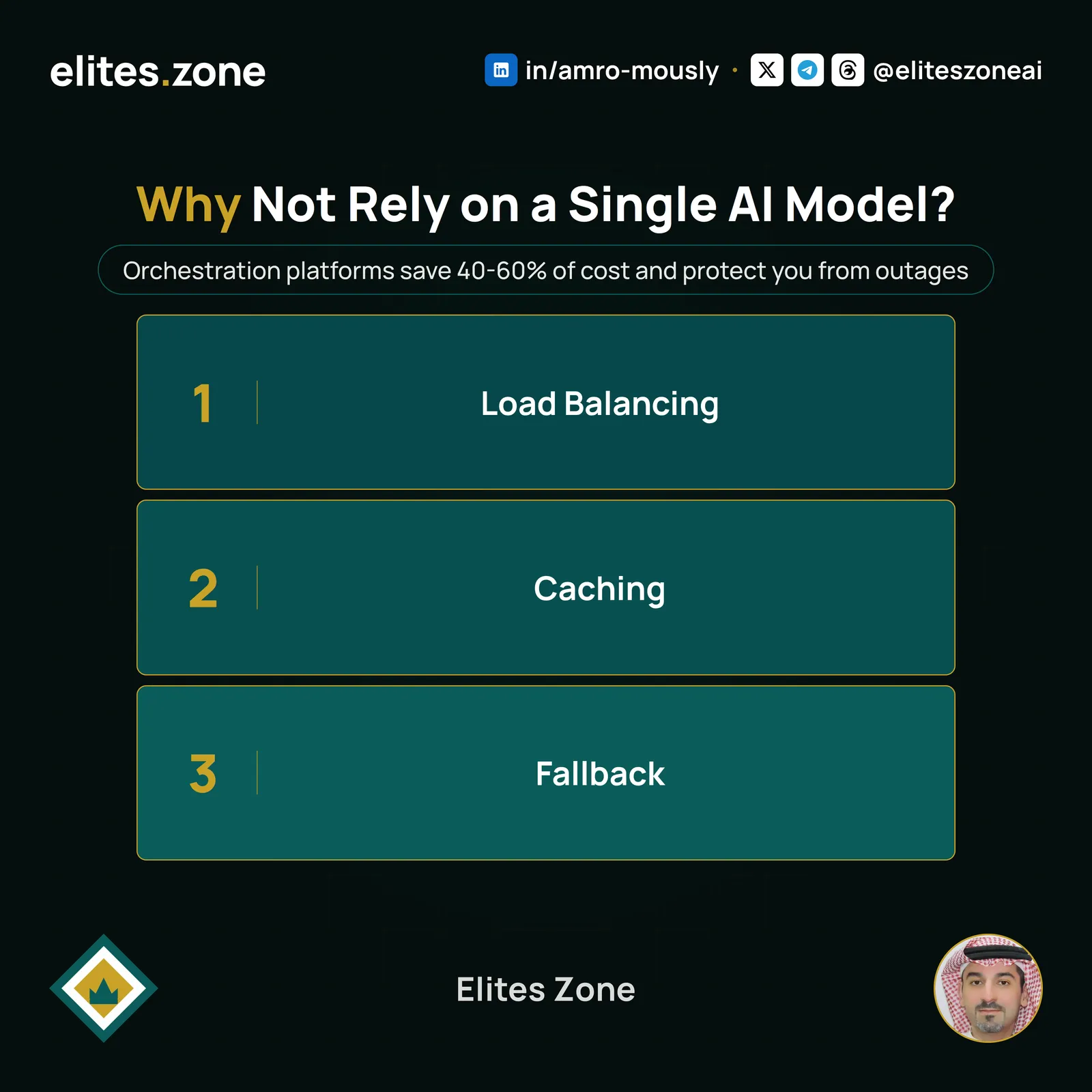
Listen to the lesson
2:57
Ask any technical founder about the biggest challenge in AI applications and they will tell you: cost and speed. And the problem is not in the models themselves — it is in how you serve them to your users.
Two years ago it was simple: take an API from OpenAI or Anthropic and wire it into your application. But as the project grows and you are handling thousands of requests a day, the problems start to show: bills in the tens of thousands, slowdowns at peak times, and a complete outage if the provider's server goes down. Whoever built their product on a single model has put every egg in one basket.
That is why orchestration platforms appeared, managing multiple models at once — LiteLLM, BentoML, Ray Serve. They let you run GPT-4, Claude and Llama behind one unified interface, routing each request to the most suitable model. And if a model goes down, the request moves automatically to the alternative.
Smart routing has become essential: you analyse the type of question before sending it. A complex question that needs deep reasoning? It goes to a powerful model. Translation or summarisation? A smaller, faster model is enough. Global companies have reported saving forty to sixty percent of cost through smart routing alone, without affecting quality — and that is the difference between a profitable project and one that burns cash.
The modern architecture has three layers: load balancing so nothing gets congested, caching for repeated questions (why pay twice for the same question?), and fallback mechanisms in case of failure. A developer working on a production application needs to think about these from day one, not once the project has grown and the fix has become expensive.
And in the Saudi market there is a further dimension: anyone serving government clients or sensitive sectors needs local or private models. Orchestration platforms let you combine open models on your own servers alongside commercial APIs — flexibility that serves both privacy and digital sovereignty.
Bottom line: if you are a technical founder, what matters is no longer which model you use, but how intelligently you manage several of them to save time and money.
Insight Score
Rate to unlock