Follow the latest AI and automation news
Amazon plans to invest $21 billion in AI infrastructure in India by 2030, while Microsoft has announced a $20.5 billion investment plan. These investments include the establishment of data centers across various states, aligning with Prime Minister Narendra Modi's ambition to host 'the world's data.' India aims to regain its status as a global service hub by focusing on dominating AI infrastructure. However, this strategy faces challenges related to resource scarcity and the impact of data centers on local communities, raising concerns about noise and energy consumption.
OpenAI informed investors that its estimated annual revenue is nearing $50 billion, a decrease from the previously indicated $70 billion. This discrepancy arises from attempts to make direct comparisons with competitor Anthropic, which calculates revenues differently. Unlike Anthropic, OpenAI does not include revenues from cloud computing partners like Amazon and Google.
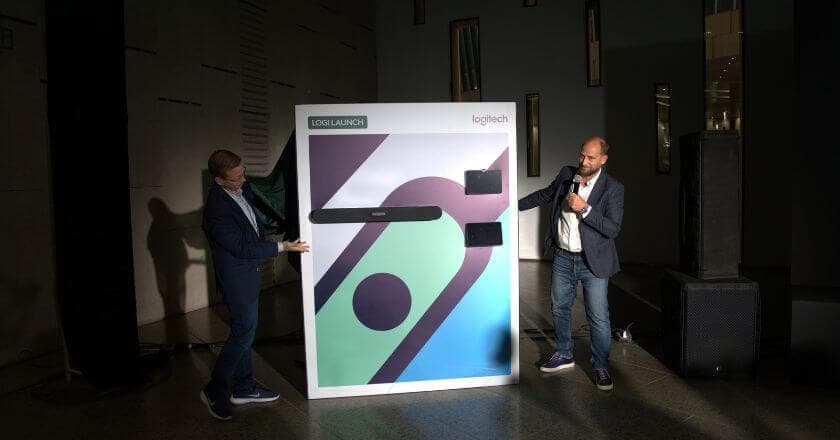
Logitech has unveiled its largest enterprise product line in history at the Grand Egyptian Museum. This new portfolio includes the Rally Bar 2, Rally System 2 Pro, and Sound Shape technology, enhancing meeting experiences across medium to extra-large workspaces. The devices are equipped with AI processing and intelligent cameras, addressing a new dual mandate for IT, according to Henry Levak, general manager of Team Workspace Solutions. Murad Ali, Head of Logitech for Business in the Middle East and Central Asia, emphasized the importance of these devices in facilitating collaboration across cities and cultures.
Nvidia has highlighted its efforts to help network operators rethink their reliance on closed AI systems. The company noted that operators such as SoftBank, AT&T, and Indosat Ooredoo Hutchison are increasingly deploying open models alongside proprietary systems, allowing them full control over sensitive network data. The findings from Nvidia's State of AI in Telecommunications 2026 survey reveal that 89% of operators consider open-source software critical to their AI strategy. Independent benchmarks show that open models are closing performance gaps, prompting operators to divide their workloads rather than depend on a single system.
At GISEC Global 2026, Dr. Vishal Gauri, CEO of Seclore, emphasized the importance of unified data discovery, classification, and persistent protection. He highlighted that AI adoption necessitates smarter security controls, prompting the need for new data protection strategies. Seclore is a leader in data protection, focusing on integrated solutions that ensure information security in AI-driven work environments. By leveraging advanced technologies, the company aims to enhance cybersecurity and meet enterprise needs.
Uygar Doyuran, Vice President and General Manager at Honeywell Technologies, emphasizes the critical role of cybersecurity in achieving industrial autonomy. He notes that increased autonomy connects more systems and data, expanding the cyber-attack surface and raising the stakes of potential breaches. This highlights the need for companies to invest in specialized cybersecurity technologies to ensure operational safety.
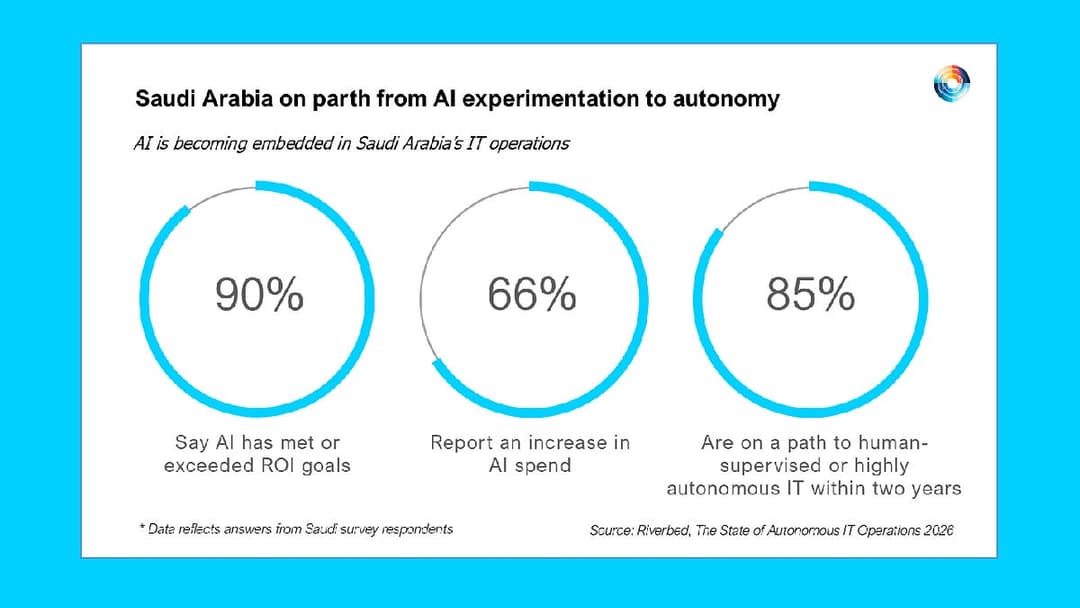
Riverbed has published its Saudi findings from the global report on Autonomous IT Operations. The results reveal that 90% of Saudi organizations report their AI initiatives have met or exceeded ROI goals, with 66% increasing AI investments over the past year. Despite these positive outcomes, the report indicates that only 22% of Saudi organizations have fully unified visibility across networks and applications. Furthermore, 85% of respondents desire human-supervised or highly autonomous IT operations within two years, highlighting visibility gaps that may limit safe automation.
AI poses a significant threat to US banks by potentially eliminating the economic advantage of cheap deposits, with estimates suggesting a loss of around $500 billion in market value. Data indicates that the average yield on US savings accounts was 0.37%, while some digital institutions offer rates exceeding 4%. JPMorgan Chase, Bank of America, and Wells Fargo reportedly hold about $1.6 trillion in non-interest-bearing deposits.
Enterprises are shifting from AI experimentation to production deployments, increasing the demand for infrastructure that integrates accelerated computing, storage, and networking. Laurent Chapoulaud, VP EMEA Marketing at PNY Technologies, highlights the company's end-to-end AI Factory approach and the role of NVIDIA RTX PRO Blackwell in enhancing local capabilities.
The discussion around artificial intelligence is shifting towards its impact on natural interest rates, with Bank of Japan Deputy Governor Shinichi Uchida proposing a new hypothesis. In a speech on October 5, Uchida described the AI boom as a 'significant positive demand shock' that could affect activity and prices, potentially raising productivity and capital accumulation.
Marvell Technology raised its fiscal 2028 revenue forecast to approximately $20 billion, exceeding Wall Street estimates, driven by increasing demand for its custom chips for data centers. The company has become a major beneficiary of the AI infrastructure investment boom, as tech firms aim to develop in-house AI processors to reduce reliance on NVIDIA chips, boosting demand for its custom solutions. Marvell expects its fiscal 2031 revenues to range between $70 billion and $90 billion, significantly surpassing Wall Street estimates, reflecting ongoing bets on expanding data center spending and demand for custom chips.
Businesses in the Middle East are transitioning from AI experimentation to practical deployment, with performance, security, and data governance shaping their technology choices. On-device and edge AI technologies are enhancing productivity and supporting sector-specific applications, while industry collaborations help organizations identify effective adoption paths. Events like AI Everything are crucial for advancing AI adoption in the region, providing a platform for knowledge sharing and solution exchange among companies.
Chinese AI startup Deep Seek is nearing the securing of at least 80 billion yuan, approximately $11.93 billion, in its latest funding round. This funding exceeds initial expectations as the company initially aimed to raise around 50 billion yuan, but investor demand surged following the successful launch of its new AI models. The current round includes significant investments from battery manufacturer CATL and Tencent Holdings, reflecting strong confidence in Deep Seek's capabilities. Last month, the company launched its new model, Deep Seek-V 4.1-Flash, which offers enhanced capabilities and faster inference.
Qualcomm has reached a patent licensing agreement with Huawei, involving U.S.-registered technologies. The arrangement encompasses Huawei's technologies related to computing, AI, networking, and 5G, as part of a broader patent cross-licensing deal. This move underscores the roles of both Qualcomm and Huawei in the global technology landscape, with executives praising each other's portfolios and their willingness to collaborate under fair terms.
OpenAI is set to launch a new form of visual ads in ChatGPT, with testing beginning in October. These ads will appear when using a specific feature, highlighting the company's strategy to expand advertising within the chatbot. This move is part of OpenAI's efforts to enhance user experience and increase revenue through advertising, allowing users to see ads seamlessly while interacting with the service. This development could change how users engage with ChatGPT, potentially impacting their interaction with content and opening new avenues for digital advertising in AI platforms.
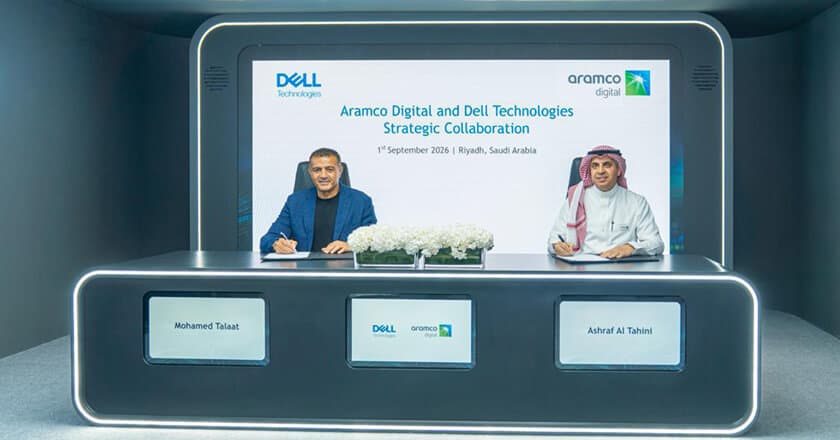
Dell Technologies and Aramco Digital signed a Memorandum of Understanding to explore opportunities for accelerating the adoption of Industrial AI and enhancing cloud consulting services in Saudi Arabia. The partnership aims to improve operational efficiency and strengthen data protection through secure and scalable Industrial AI solutions, focusing on joint initiatives to expand access to Dell Technologies' solutions through authorized channel partners.
Deutsche Telekom expects to achieve savings of €2.5 billion by 2030 through the use of artificial intelligence. This transformation includes leveraging AI to enhance operational efficiency and improve customer service. The company aims for additional savings of €1.1 billion by 2027, reflecting its commitment to reinvest these savings into digital infrastructure. This strategy highlights the use of efficiency gains to fund future investments rather than merely reducing expenses.
Al Moammar Information Systems, based in Riyadh, has received its first work order from HUMAIN, the AI company owned by the Public Investment Fund, valued at $500 million. The order was received on October 1 and covers 50 megawatts of AI data center capacity, equating to 148% of MIS's projected revenue for 2025. This deal is part of a prior agreement signed in September, which aims to increase planned capacity to 250 megawatts. This significant commitment from HUMAIN underscores MIS's ability to deliver the overall capacity and highlights the role of domestic firms in large-scale infrastructure development.
Artificial intelligence is rapidly reshaping the workplace, with a PwC survey revealing that 64% of workers used generative AI tools in the past year, a 10-point increase. In contrast, 36% of participants did not use these tools, highlighting a clear gap between adopters and non-adopters. The findings indicate that workers known as the 'Engine Room' group make up the majority of the workforce but feel replaceable. Furthermore, the adoption of AI agents remains lagging, with 48% of participants reporting they have not used these tools.
Harish Chib, Vice President of Sales at Sophos, discussed the importance of protecting critical infrastructure through AI-led security operations. Organizations must secure IT, operational technology, and cloud environments while responding to threats more rapidly. Chib explained that cyber resilience goes beyond merely preventing attacks; organizations must maintain operational continuity during active incident investigations. This requires a layered defense that allows organizations to prevent, detect, respond to, and recover from cyber incidents.
Kaspersky reveals that Gen Z is particularly aware of AI technologies in education, viewing them as a promising area. According to new research, 18% of Gen Z identify personalized AI tutors as the most promising technology, surpassing other generations. Additionally, 68% of Gen Z have noticed increased technology use in their education over the past five years, laying the groundwork for a larger transformation in learning.
Documents from Anthropic's IPO reveal a partnership with Broadcom, which will provide computing capabilities and equipment leasing. Broadcom is set to lend Anthropic up to $42 billion, enhancing its role in the company's infrastructure expansion. This partnership is unique compared to other partners like Amazon, which focuses on cloud infrastructure. Anthropic is expected to become Broadcom's largest client in chip design, raising concerns about mutual spending in the AI market.
Lenovo has announced the launch of Lenovo AI Express, an accelerated path to AI deployment aimed at removing complexities. According to the Lenovo 2026 CIO Playbook, 94% of respondents expect positive returns from their AI investments, with an average return of $2.78 for every $1 invested. Lenovo AI Express, in collaboration with NVIDIA, addresses barriers to AI implementation by providing rapid access to AI capabilities and validated configurations. Customers can start with solutions tailored to their current needs, with the ability to scale as demands grow, with order-to-ship times accelerated to 15 business days for eligible configurations.
Tencent is set to lease approximately 100,000 advanced AI chips from Oracle in what marks the largest external leasing deal for the Chinese company. The agreement, which spans five years, involves several Oracle data centers in Southeast Asia, with the deal valued at around $7 billion. This deal highlights Tencent's sharply rising demand for computing capabilities as the company ramps up investments in developing large language models. Recently, Tencent launched a beta version of a new AI image generation model tailored for professional creators, offering features to convert text to images and vice versa.
Google announced that its data center growth, driven by the AI boom, led to a power-purchase agreement with Constellation. Through this agreement, Google will add over 1.5GW of nuclear capacity to the US energy system by increasing output from existing reactors. This move comes as tech companies face criticism over the surge in data center construction, which raises energy demand and electricity prices for consumers. Google reiterated its commitment to revitalizing the nation's energy supply and supporting local jobs.
OpenAI's annual revenue stands at approximately $50 billion, significantly lower than the previously reported $70 billion figure. This adjustment negatively impacted chip stocks, highlighting the financial evaluations' influence on the market. Currently, OpenAI is negotiating to raise $30 billion in fresh capital, reflecting a valuation of $1.4 trillion, underscoring the importance of its future investments.
Oracle has announced the integration of ChatGPT Work and Codex to enhance work efficiency across recruiting, engineering, and operations. These technologies enable the transformation of specialized knowledge into fast, repeatable workflows, streamlining the execution of complex tasks more effectively. This initiative is significant for fostering innovation in work environments, as it can help organizations achieve better outcomes and reduce the time spent on daily operations.
LegalOn has successfully reduced its daily Codex costs by 65% while maintaining development speed. The company strategically matched Astra, Sol, and Luna to tasks and managed budgets effectively. This move is significant in enhancing operational efficiency, allowing LegalOn to utilize resources more effectively. This achievement reflects the company's ability to improve performance while reducing costs, making it more competitive in the market.
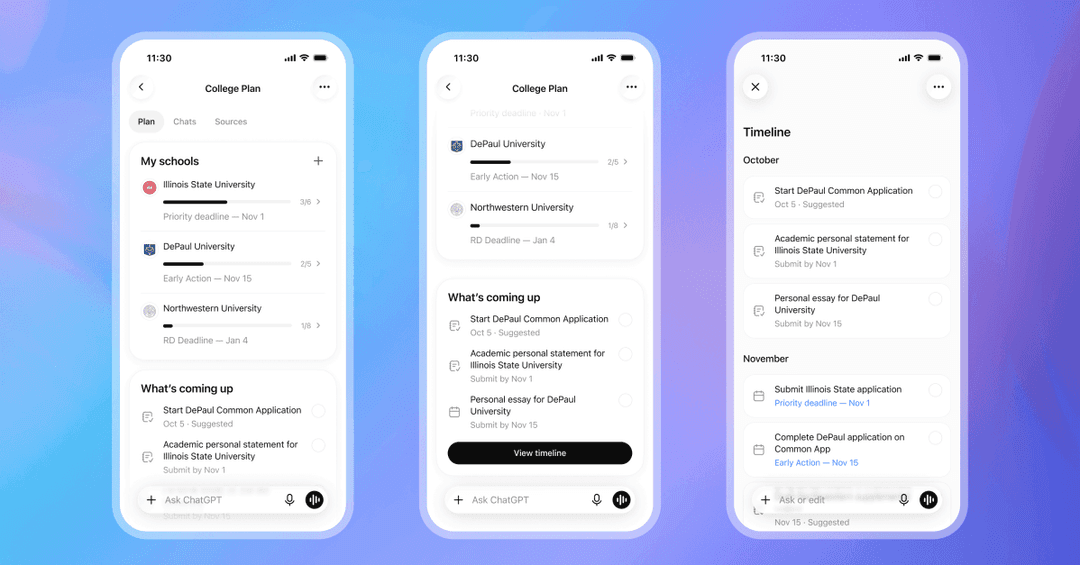
OpenAI has announced a new tool for ChatGPT Teens, called the College Planner, designed to assist students with the college application process. This tool consolidates application requirements, deadlines, tasks, and financial aid steps into one comprehensive plan. Students applying to multiple colleges can update their progress, utilize a timeline to plan ahead, and see what tasks remain. They can also ask ChatGPT questions about specific requirements or how to get started with their applications.
The US government has launched the Tradewinds initiative to facilitate funding for nontraditional defense contractors, including OpenAI, Anthropic, and Google. This initiative allows millions of dollars to be directed towards tech companies that have not traditionally been part of the defense sector, reflecting a shift in defense spending strategy. This shift presents a significant opportunity for these companies to expand their operations in defense, potentially leading to new innovations in AI technologies used for national security.