Article
Three AI Governance Models — Which One Should You Follow?
Europe imposes a comprehensive law, America relies on voluntary standards, and China requires every algorithm to be registered. The Gulf is building its framework from all three — what does that mean for your product?
 FounderAmro MouslyArtificial Intelligence · Technology Strategy · Entrepreneurship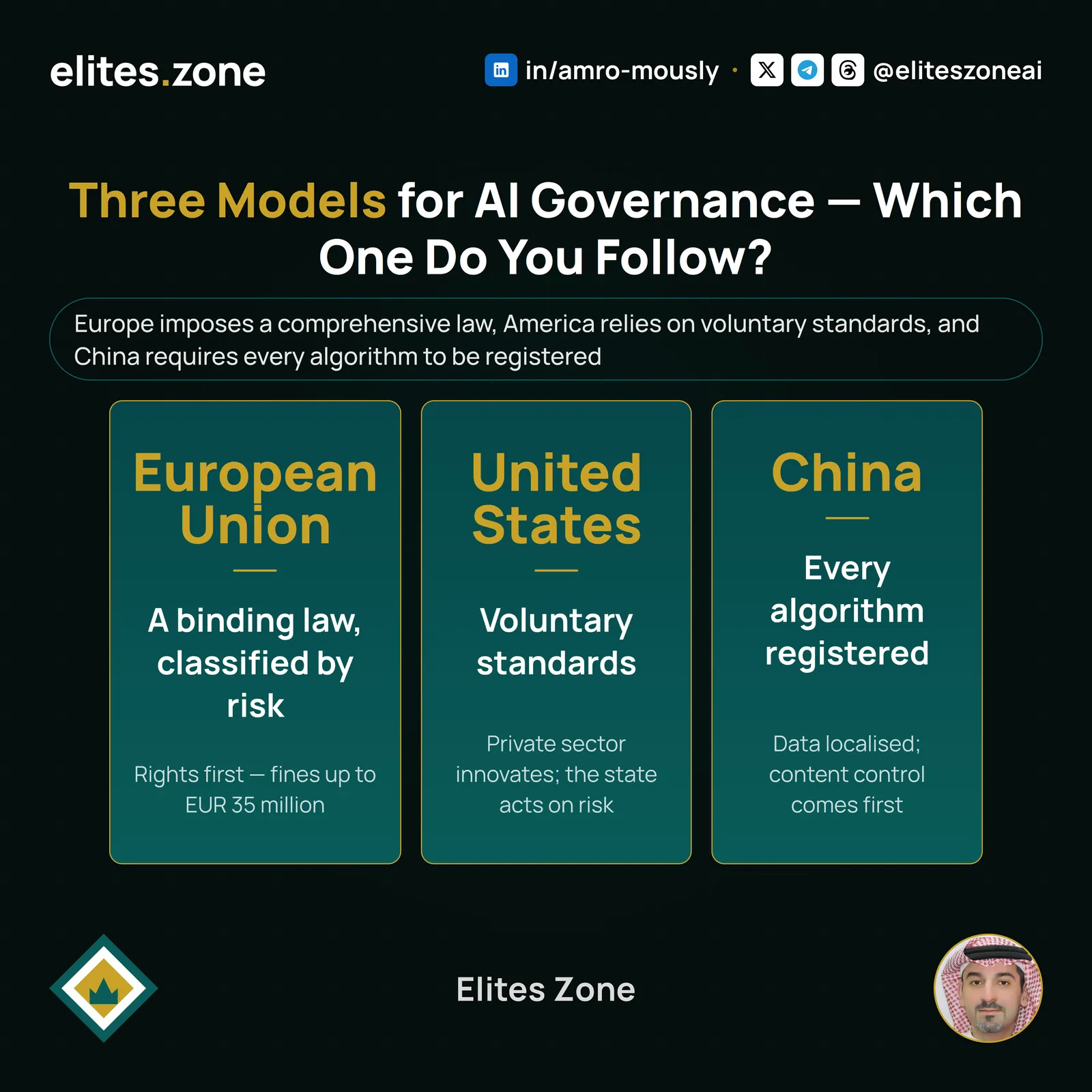
Listen to the lesson
2:53
If you are building an AI product in Riyadh or Dubai today, you will face an important question: which regulatory model do you follow? There are three schools in the world, and the Gulf draws on all of them.
Europe imposes a comprehensive law — the EU AI Act — classifying systems by their risk: some are banned outright, such as social scoring; some are high-risk, such as hiring and credit, and need strict auditing; and some are limited, where a simple disclosure is enough. Fines reach seven percent of your global revenue. Their principle: protect people's rights first, and innovation after.
America went the opposite way entirely: no binding federal law. Most standards are voluntary, and the bet is that the private sector innovates with the least possible government intervention.
China treats it as information security: every algorithm must be registered with the competent authority, and your sensitive data has to stay inside the country. Their focus is control and stability rather than technical risk. If your model generates content, you will need approval before you launch it.
And the Gulf is building its own model: SDAIA — the Saudi Data and AI Authority — has issued governance principles that draw on all three: risk classification from Europe, implementation flexibility from America, and cybersecurity from China. The UAE is on the same line, focused on transparency without complexity.
So what does this mean for you as a decision-maker? If you want to sell in Europe, you will need full documentation of your training data. If you want to enter China, you will need a local partner and prior registration. And if you are building for several markets, you will need different versions of your product to satisfy each framework.
Bottom line: you are not required to follow a single model — you are required to understand which market you are targeting. Start with the SDAIA principles and keep your architecture flexible, so you can add compliance layers without rebuilding everything. The companies that succeed are the ones that make compliance a competitive advantage from day one.
Insight Score
Rate to unlock