Article
Your Personal and Organisational AI Plan
The closing lesson of the Foundations series: how to build a clear AI plan that starts from the problem, grades the risk, and settles the data, the boundaries, the return, and the next small step.
 FounderAmro MouslyArtificial Intelligence · Technology Strategy · Entrepreneurship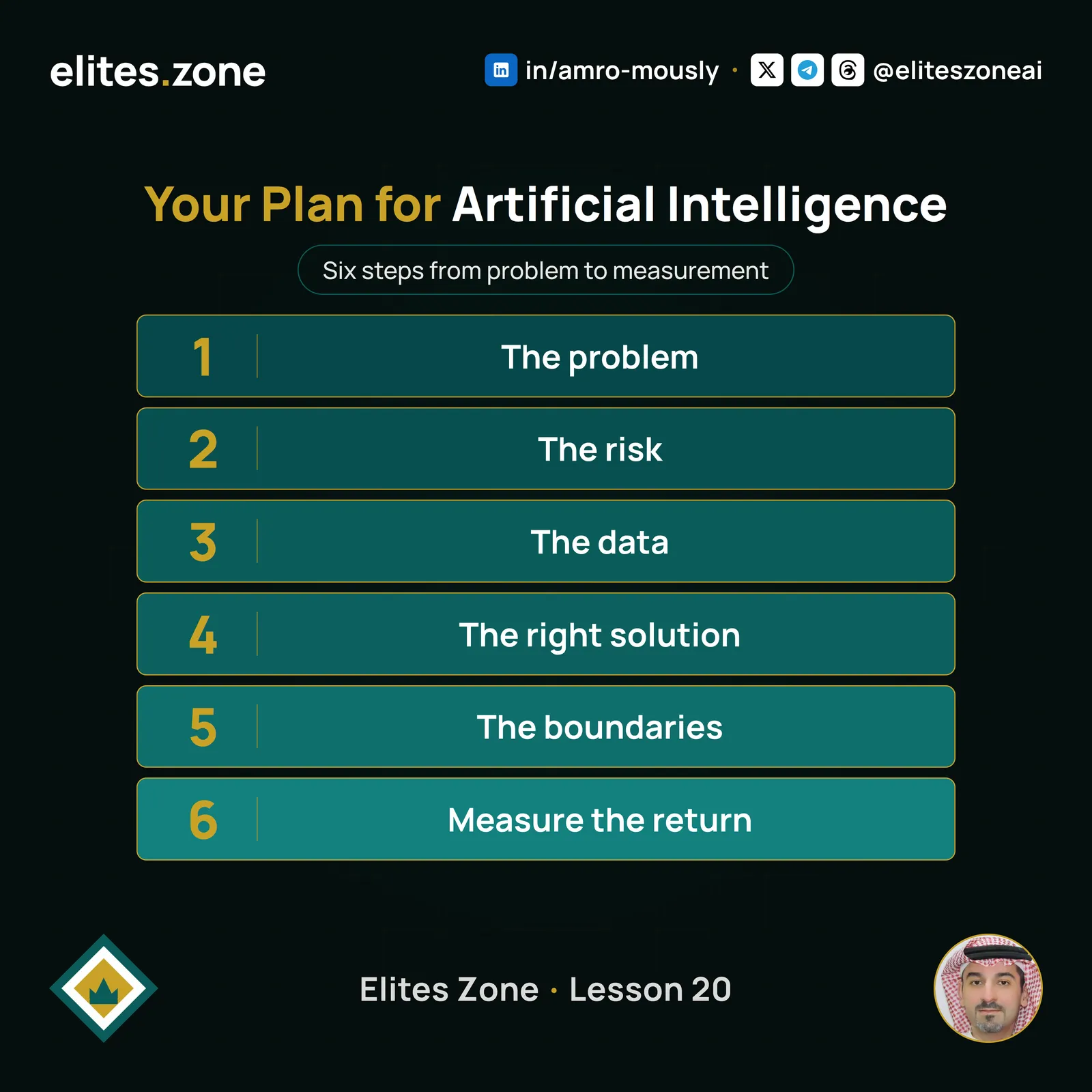
Listen to the lesson
3:47
We have reached the last lesson of this series.
We started from a simple question: what is AI, actually?
And moved step by step: how to ask, how to tell automation from an agent, how to watch for hallucination, how to choose a model, when to build or buy, when you need your own files, and how to think about context, privacy, return, practical uses, ethics, security, jobs, and the opportunity in our Arab and Saudi world.
Now the practical question:
How do you build a clear plan?
You are not required to use every tool. Or build a large system on day one. Or put AI into every decision.
You are required to start from a real problem.
One: define the problem. Where does the time go? What is the repeated task? What needs organising, summarising, a first draft, or a clearer decision?
Two: grade the risk. Is the task straightforward? Or does it involve a customer, money, health, law, or someone's rights?
The higher the risk, the greater the need for human review and explicit boundaries.
Three: understand the data. Is it public? Internal? Confidential? Or genuinely sensitive?
If it is sensitive, don't treat it as ordinary text. Think about permissions, privacy, and possibly a private or local model.
Four: choose the right solution. An off-the-shelf tool? Simple automation? An agentic workflow? An AI agent?
Don't start with the most powerful. Start with the simplest thing that solves the problem.
Five: set the boundaries. Ask plainly:
What do we allow AI to do? What must stay in human hands? When does it need approval? And who reviews the result?
Those boundaries are what turn scattered experimentation into responsible use.
Six: measure the return. Measure the current state before you try anything. Then ask:
Did we save time? Did errors drop? Did quality improve? Did the decision get clearer?
Without measurement, AI is just enthusiasm.
Personally, your plan can be simple:
Use it to organise your day, simplify what you are learning, write first drafts, and help you see your options clearly.
At work or across an organisation, your plan starts from one task:
Customer service, reports, content, repeated operations, or internal knowledge that needs organising.
Start with a small trial. Review the result. Learn from it. Then expand, calmly.
The bottom line: AI is not a goal in itself.
It is a means.
Its value shows when it serves your understanding, your time, your work, and your decisions — without removing your responsibility.
This series was not about memorising terms. It was about building a way of thinking.
From here, don't only ask: "What is the new tool?"
Ask:
What is the problem? What is the data? What is the risk? What are the boundaries? What is the return? And what is the small step I can start with today?
That is where you move from following to applying.
From knowledge to practice.
Quick Check
Before you continue, answer two questions to check the core idea.
- Question 1
Where does a sound AI plan start?
- Question 2
What is the best way to expand your use of AI?
Insight Score
Rate to unlock