Article
Build or Buy? How to Decide on AI Solutions
Whether to build or buy an AI solution comes down to how specific the problem is, how sensitive the data is, how often it repeats, and what it costs. This lesson covers when an off-the-shelf tool is right and when a custom build earns its keep.
 FounderAmro MouslyArtificial Intelligence · Technology Strategy · Entrepreneurship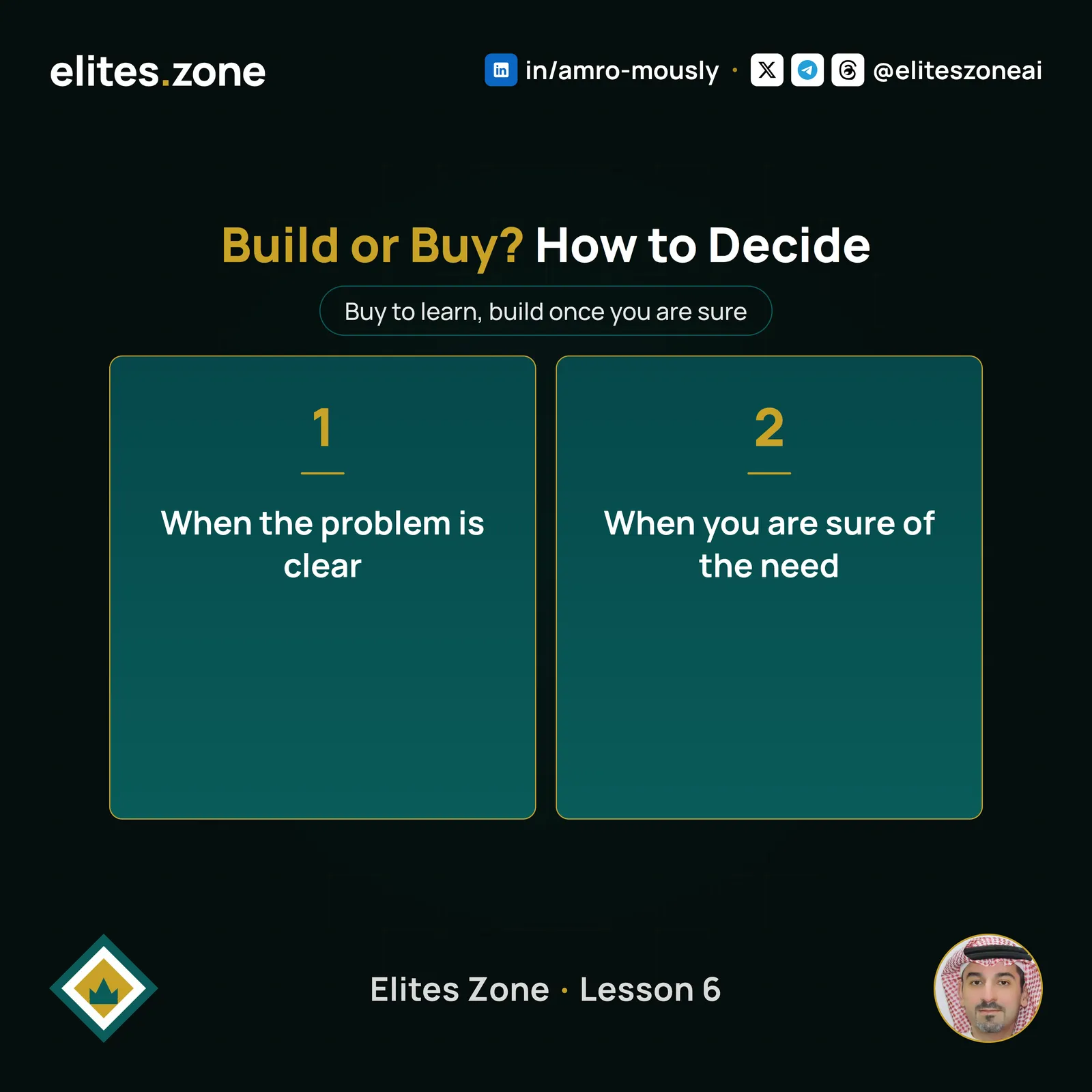
Listen to the lesson
3:24
One of the first real questions once you start using AI in your business:
Do I build this myself, or buy something ready-made?
There is no single answer.
Sometimes buying is the smarter call. Sometimes building gives you control you actually need. And sometimes you buy in order to learn, then build once you are sure.
Here is the comparison that makes it concrete.
If you want coffee every morning you have options: buy a cup, buy a machine, or build a full coffee setup.
Each has its logic.
Want it solved quickly? The cup is fine. Drinking it daily? The machine makes sense. Quality and detail matter enormously to you? Then perhaps the full setup.
AI solutions follow the same shape.
Buying suits a clear problem, where the capability already exists, and speed matters more than customisation.
For instance: a tool that summarises meetings, drafts first versions, organises knowledge, or assists support.
The advantage is that you start quickly. You are not building from zero, running servers, or fixing a long tail of technical faults.
But buying has limits.
The tool may not fit how you actually work. Cost can climb with your user count. Your data may be sensitive. And you depend on a vendor who can change the price or the feature whenever they like.
So when do you build?
Build when the problem is specific, repeated, and important enough.
An internal workflow no off-the-shelf tool fits, sensitive data, a particular user experience, or usage large enough to make subscriptions expensive — those make building worth considering.
But building is not a magic button.
It takes time, testing, maintenance and ownership. If the system gets something wrong, who watches it? If it stops, who fixes it? If the need changes, who updates it?
Which is why you don't start with the big build on day one.
Start with a simpler question:
What is the actual job here?
Where is the time going? How often does this problem recur? Who uses the solution? What data does it need? And what must stay under human review?
If the answer isn't clear, start with a small trial.
Buy to learn, build once you're sure.
Use a ready-made tool or a light experiment to understand the problem, then decide whether it deserves something custom.
The bottom line: Don't choose build or buy on enthusiasm.
Buy when you need to start quickly and the problem is clear. Build when the problem is specific, repeated, sensitive, or part of what makes your business valuable.
The question is not which option is more impressive. It is which option fits the job right now.
Quick Check
Before you continue, answer two questions to check the core idea.
- Question 1
When is buying an off-the-shelf tool the right call?
- Question 2
What does "buy to learn, build once you are sure" mean?
Insight Score
Rate to unlock